
Fire Ant Control Science: How Fire Ants Spread and Survive
Fire ant control science explains how fire ants establish colonies, expand quickly, and survive many common treatments. At first glance, fire ants may appear simple. However, beneath the surface, their survival depends on complex social systems, underground networks, and coordinated behavior.
At Dr. Green Services, fire ant control follows science first. Instead of reacting only to visible mounds, professional treatments focus on how colonies function as a whole. As a result, control efforts target the true source of infestations rather than short-term symptoms.
Fire Ant Control Science and Colony Behavior
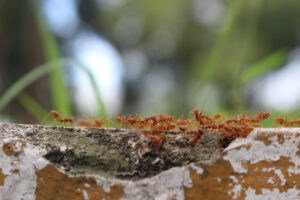
To begin with, research shows that fire ants do not operate as individual insects. Instead, they function as a single unit often described as a superorganism. Every worker ant, tunnel, and mound exists to protect the colony and support reproduction.
Because of this structure, fire ants respond quickly to threats. When disturbed, they relocate, rebuild, or divide into multiple groups. Therefore, treatments that rely only on surface disruption rarely provide lasting results.
Understanding this behavior is essential for long-term fire ant management.
Fire Ant Control Science and Underground Colony Growth
Colonies develop entirely below the soil surface. In many cases, a single colony contains hundreds of thousands of ants. At the center of each colony, one or more queens drive reproduction. In fact, many of the same principles discussed in turf-damaging insect science apply to fire ants, since both cause damage and disruption below the soil surface long before problems appear above ground.
As long as the queen survives, the colony remains active. Consequently, worker ants focus on feeding, defending, and relocating the queen when necessary. Research shows colonies expand through:
-
Mating flights that create new colonies
-
Colony splitting after disturbance
-
Underground relocation to safer soil conditions
Because most activity happens below ground, visible mounds reveal only part of the infestation.
Fire Ant Control Science Explains Why Mounds Return
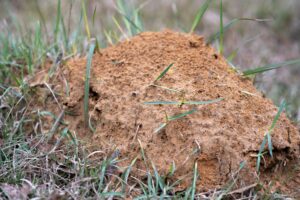
Many homeowners focus on removing fire ant mounds. However, scientific research shows that mounds are temporary structures rather than permanent nests. Instead, they act as access points that help regulate temperature and moisture.
When a mound is destroyed, fire ants respond immediately. As a result, workers rebuild nearby or move deeper underground. In some situations, repeated disturbance actually strengthens colony survival behavior.
For this reason, mound removal alone rarely leads to lasting control.
Why Fire Ant Control Science Shows Surface Treatments Fail
Although store-bought products may seem effective at first, they usually kill only a small number of visible ants. Meanwhile, the queen and the majority of the colony remain protected underground. According to research on fire ant biology and colony behavior from Texas A&M AgriLife Extension, most fire ant activity occurs below the soil surface, which explains why surface-level treatments often fall short.
Even worse, incomplete treatments can cause colonies to split. As a result, one infestation can quickly turn into several active colonies. Similar challenges also appear in grub control science, where insects survive and feed below the surface long before visible damage appears above ground. Because of this, surface-level treatments often fail to solve the underlying problem.
Instead, successful strategies focus on how treatments move through the colony, reaching workers and queens alike. By targeting underground activity, these approaches address the root of the infestation rather than relying on immediate surface results.
How Fire Ant Control Science Guides Professional Treatments
Professional fire ant control works by aligning treatment methods with ant behavior. Rather than relying only on contact, applications are designed to spread naturally through worker activity.
Specifically, proven strategies:
-
Target worker ants that feed the colony
-
Allow products to transfer underground
-
Disrupt reproduction and colony growth
-
Reduce rebound and reinfestation risk
Because of this approach, professional treatments deliver longer-lasting results than surface applications alone.
Environmental Factors That Influence Fire Ant Activity
Environmental conditions strongly influence fire ant behavior. For example, warm temperatures and moist soil encourage colony expansion. After rainfall or irrigation, colonies often move upward, which increases visible mound activity. Many of these conditions are also explained in lawn care science, which shows how moisture, soil structure, and turf health influence insect activity below the surface.
In warmer regions, fire ants may remain active for much of the year. As conditions change, colonies adjust their depth and location underground. Therefore, timing plays a critical role in effective treatment.
Ongoing monitoring ensures applications occur when colonies are most vulnerable.
Why Fire Ant Control Science Matters Long-Term
Ultimately, science shows that lasting results require more than quick fixes. Instead, effective control depends on understanding how fire ants adapt, organize, and survive underground. Without that knowledge, many treatments miss the real problem and allow colonies to recover.
At Dr. Green Services, professional fire ant control applies proven research and real-world experience to target colonies below the surface. By doing so, treatments reach the queen, disrupt reproduction, and reduce reinfestation. As a result, this science-based approach delivers safer, longer-lasting protection.
In the end, understanding how fire ants behave is the key to stopping infestations—and keeping them from coming back. For homeowners who want to explore related topics in more detail, Dr. Green Services offers additional guidance in our lawn care resources.
Hear What Our Happy Customers Have to Say!
For a Limited Time
Get Started Today and Enjoy Our Special Offer: Free Grub Control, Free Aeration, Free Fungicide, and Free Turf-Damaging Insect Control! Plus, Save 10% When You Prepay!
Your Local Lawn Care Experts
Dallas-Fort Worth
Address
3333 Earhart Dr., Suite 200
Carrollton, TX 75006
Phone Number
1-800-465-2934
Ready to elevate your lawn care game?
Get a free quote today.