
Tree Insect Damage Science
Tree and shrub insect damage is not random, sudden, or purely cosmetic. Instead, it develops through predictable biological interactions between insects, plant physiology, and environmental stress. As explained in tree and shrub care science, understanding how insects feed, reproduce, and exploit weakened plants allows damage to be identified earlier and interpreted more accurately.
This science-based perspective explains why visible symptoms often appear long after damage begins and why effective management depends on timing, plant health, and insect behavior rather than reaction alone.
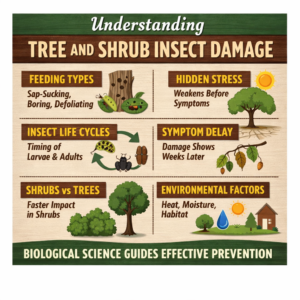
How Tree Insect Damage Affects Woody Plants
Insects harm woody plants by interfering with internal systems that support growth and survival. Sap-feeding insects disrupt nutrient movement. Borers restrict water transport. Defoliators reduce the plant’s ability to produce energy. As outlined by Penn State Extension’s research on tree and shrub pests and diseases, these feeding behaviors interfere with normal plant function long before external symptoms appear.
Each feeding method affects plant function differently. However, all require sustained access to living tissue. Because trees and shrubs store energy over multiple seasons, early feeding often goes unnoticed while internal stress builds.
Tree Insect Damage and Plant Stress Response
Plant stress directly increases vulnerability to insect activity. Drought, compacted soil, nutrient imbalance, and root disturbance weaken natural defense responses.
Healthy plants regulate nutrients efficiently, produce protective compounds, and isolate damaged tissue. Stressed plants lose this control. As a result, insects feed more successfully and remain active longer, which accelerates decline.
This relationship explains why insect pressure often rises after stress events instead of appearing without warning.
Feeding Activity Versus Visible Symptoms
Visible symptoms rarely show the full extent of insect-related injury. Yellowing leaves, thinning canopies, and early leaf drop reflect how plants respond, not how much feeding occurred, which is why tree and shrub disease science is also critical for accurate diagnosis.
Some insects disrupt vascular systems, which causes delayed decline. Others apply repeated low-level pressure that compounds over time. In both cases, symptoms often emerge weeks or months after feeding begins.
Accurate evaluation relies on understanding timing and feeding behavior rather than surface appearance alone.
Tree Insect Damage and Insect Life Cycles
Insect development stages control when damage occurs and where it concentrates. Larval stages usually cause the most internal disruption, while adults focus on movement and reproduction.
Some species feed intensely during short seasonal windows. Others apply pressure across multiple generations. Because woody plants respond slowly, damage from early stages may not appear until much later.
Recognizing these cycles improves prediction and reduces misdiagnosis.
Why Shrubs Respond Faster Than Trees
Shrubs often show damage sooner because they store fewer reserves and rely on shallower root systems. Faster symptom development does not always indicate greater severity, but it reduces recovery time.
Trees tolerate feeding longer due to larger storage capacity. However, they may continue declining even after insect activity slows. Growth habit and energy storage strongly influence how damage develops.
Understanding these differences prevents conclusions based only on speed.
Environmental Conditions That Increase Insect Pressure
Warm temperatures, steady moisture, and protected habitats allow insect populations to persist. Urban environments often intensify these conditions through heat retention, irrigation patterns, and reduced predator presence.
As a result, insect activity frequently concentrates near structures, sheltered planting zones, and transition areas. Environmental awareness explains why pressure often appears localized and repeatable.
Interpreting Tree Insect Damage as a Biological System
Tree insect damage develops through interacting biological factors rather than isolated events. Feeding behavior, plant condition, seasonal timing, and environmental influence all shape outcomes. This systems-based understanding supports science-guided decisions used in professional tree and shrub care service programs.
When these factors guide interpretation, damage patterns become predictable. Prevention becomes more effective than reaction. Long-term plant health becomes measurable instead of speculative, which is why broader lawn care resources help connect insect biology with overall property management.
Science-driven evaluation turns insect damage into a manageable biological process rather than an unexpected problem.
Hear What Our Happy Customers Have to Say!
For a Limited Time
Get Started Today and Enjoy Our Special Offer: Free Grub Control, Free Aeration, Free Fungicide, and Free Turf-Damaging Insect Control! Plus, Save 10% When You Prepay!
Your Local Lawn Care Experts
Dallas-Fort Worth
Address
3333 Earhart Dr., Suite 200
Carrollton, TX 75006
Phone Number
1-800-465-2934
Ready to elevate your lawn care game?
Get a free quote today.