
Brown Patch Fungus Science
Brown patch is one of the most researched and widespread lawn diseases affecting cool-season turf. Because of this, understanding brown patch fungus science helps explain why the disease appears suddenly, spreads quickly, and often returns during periods of summer stress.
Rather than behaving unpredictably, brown patch follows well-documented biological rules rooted in lawn care science, including turf physiology, environmental stress, and fungal growth conditions. When these factors align, lawns become vulnerable long before visible symptoms appear on the surface.
Therefore, this page focuses on the science behind brown patch development as part of a broader lawn fungus science framework, not just what the disease looks like. By understanding why the disease occurs, long-term prevention becomes far more effective and predictable.
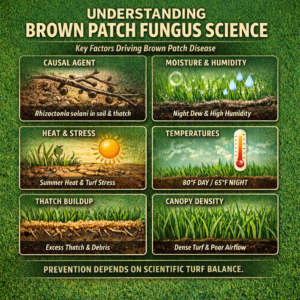
Brown Patch Fungus Science and Disease Biology
Brown patch fungus science begins with plant pathology. The disease is caused by Rhizoctonia solani, a soil-borne fungus that naturally exists in turfgrass systems, as documented in university research on Rhizoctonia solani.
As a result, the fungus does not need to be introduced from outside sources to cause damage. Instead, it survives in soil, thatch, and organic debris. It remains inactive until environmental conditions favor growth.
Once activated, the fungus primarily infects leaf tissue rather than roots. Because of this, lawns may remain firmly rooted yet show rapid thinning and discoloration above ground.
Additionally, infection spreads through direct contact between grass blades. Therefore, dense turf canopies increase blade-to-blade contact and accelerate disease progression when moisture is present.
Brown Patch Fungus Science and Turf Stress
Turf stress is a central concept in brown patch fungus science. Under normal conditions, healthy grass can tolerate low levels of fungal activity without visible decline. However, stressed turf loses this natural defense.
For example, heat stress increases respiration rates and drains stored energy. Meanwhile, drought stress weakens cell structure. In addition, soil compaction limits oxygen availability. Together, these factors reduce the turf’s ability to resist infection.
As stress accumulates, fungal activity increases. Consequently, brown patch often develops in lawns that receive regular maintenance but experience environmental stress beyond the plant’s tolerance.
Brown Patch Fungus Science and Moisture Conditions
Moisture plays a critical role in brown patch fungus science. In fact, the fungus requires extended leaf wetness to infect turfgrass tissue effectively.
For this reason, nighttime irrigation, prolonged dew, and high humidity create ideal conditions. When grass blades remain wet for several consecutive hours, fungal growth accelerates rapidly—unlike stress-driven diseases such as fusarium blight, which develop under very different environmental conditions.
Importantly, saturated soil is not required. Even well-drained lawns can develop brown patch if leaf surfaces remain wet. Therefore, outbreaks often correlate more closely with humidity than with rainfall totals.
Temperature Thresholds in Brown Patch Fungus Science
Temperature strongly influences disease activity. According to brown patch fungus science, the disease becomes most active when nighttime temperatures remain above 65°F and daytime temperatures exceed 80°F.
During these conditions, turfgrass experiences increased metabolic stress. At the same time, fungal growth rates peak. As a result, a narrow but high-risk biological window forms.
Because these thresholds are predictable, brown patch outbreaks tend to occur during the same seasonal periods each year. Rather than following calendar dates, the disease responds to environmental signals.
Brown Patch Fungus Science and Nitrogen Response
Nitrogen availability significantly influences brown patch fungus science. When nitrogen levels are excessive, rapid leaf growth occurs. As a result, turf produces soft tissue that is more susceptible to infection.
In addition, fast growth increases canopy density. Dense turf traps moisture and reduces airflow, which extends leaf wetness periods. Consequently, fungal spread accelerates even in lawns that appear healthy.
By contrast, balanced fertility supports steady growth without overstimulation. Therefore, turf strength improves and disease pressure declines during peak stress periods.
Brown Patch Fungus Science and Canopy Density
Canopy structure plays a major role in disease development. Specifically, dense, upright growth increases blade-to-blade contact and traps humidity near the soil surface.
Because airflow becomes restricted, evaporation slows. As a result, a favorable microclimate forms that supports fungal activity. In some cases, this allows infection to persist even during dry weather patterns.
Therefore, managing canopy density through proper mowing height and growth regulation improves surface drying and reduces disease pressure without stressing the turf.
Environmental Stress Interactions That Increase Disease Pressure
Brown patch rarely develops due to a single factor. Instead, environmental stressors often overlap and amplify one another.
For example, extended cloud cover reduces photosynthesis. Meanwhile, high nighttime humidity slows plant recovery. In addition, poor air circulation traps moisture within the canopy. Each condition weakens turf defenses and increases vulnerability.
When multiple stressors occur together, turf energy reserves decline faster. Consequently, disease development becomes more likely even in well-maintained lawns — a pattern also reflected in dollar spot disease science, where prolonged moisture and reduced turf resilience create similar infection pressure.
The Role of Thatch and Organic Matter Accumulation
Thatch influences disease activity by altering moisture retention and airflow near the soil surface. When excessive thatch is present, moisture remains trapped against leaf tissue. As a result, leaf wetness duration increases.
Additionally, organic debris provides a stable environment for fungal survival between growing seasons. Therefore, when thatch accumulates faster than it decomposes, disease pressure rises.
Managing organic buildup improves drying conditions and reduces long-term disease persistence.
Why Visual Symptoms Appear After Infection Is Established
One of the most misunderstood aspects of lawn disease is timing. In many cases, visible symptoms appear well after infection begins.
Fungal activity starts at the microscopic level. By the time discoloration or thinning becomes noticeable, infection may already be widespread throughout the canopy. Because of this delay, early activity often goes unnoticed.
This timing explains why reactive treatments often feel ineffective. By then, damage has already occurred before symptoms prompt action.
How Mowing Practices Influence Disease Development
Mowing height and frequency directly affect turf stress and recovery. When grass is cut too short, leaf surface area decreases. As a result, energy production declines.
Meanwhile, frequent mowing during peak heat increases physical stress and creates open wounds on leaf tissue. These wounds, in turn, provide additional entry points for infection.
Therefore, maintaining proper mowing height improves airflow, strengthens leaf tissue, and supports recovery during high-risk periods.
Why Brown Patch Fungus Science Explains Recurring Outbreaks
Brown patch returns because the fungus never fully disappears. Brown patch fungus science confirms that Rhizoctonia survives year-round in soil, thatch, and plant debris.
When temperature, moisture, and stress conditions align again, fungal activity resumes. Consequently, treating visible symptoms alone does not interrupt this cycle.
Over time, reducing turf stress and improving growing conditions limits future outbreaks and decreases their severity.
How Brown Patch Fungus Science Guides Lawn Care Decisions
Understanding brown patch fungus science changes how disease is managed. Instead of focusing only on appearance, science-based programs emphasize turf health and environmental balance.
When lawn care decisions align with fungal biology and plant response, results become more predictable. As a result, lawns recover faster, tolerate summer stress better, and maintain consistent growth.
At Dr. Green Services, lawn fungus management follows lawn care science rather than guesswork. Therefore, this approach delivers long-term improvement instead of short-term correction.
The Role of Brown Patch Fungus Science in Long-Term Lawn Health
Brown patch fungus science reinforces a broader principle in turf management. Rather than reacting to symptoms, disease prevention depends on balance and consistent lawn care resources rooted in proven turf science.
Lawns with stable growth, strong roots, proper airflow, and controlled moisture develop natural resistance over time. Consequently, as stress declines, disease pressure follows, reducing the need for corrective fungus service applications.
Ultimately, this science-driven approach supports healthier lawns and more reliable performance season after season.
Hear What Our Happy Customers Have to Say!
For a Limited Time
Get Started Today and Enjoy Our Special Offer: Free Grub Control, Free Aeration, Free Fungicide, and Free Turf-Damaging Insect Control! Plus, Save 10% When You Prepay!
Your Local Lawn Care Experts
Dallas-Fort Worth
Address
3333 Earhart Dr., Suite 200
Carrollton, TX 75006
Phone Number
1-800-465-2934
Ready to elevate your lawn care game?
Get a free quote today.