
Dollar Spot Disease Science: How This Lawn Fungus Develops
Dollar spot disease science explains why this lawn fungus appears suddenly, spreads quickly, and often returns under similar conditions year after year. Rather than being random, dollar spot follows predictable biological patterns tied to turf stress, moisture dynamics, and nutrient balance — principles that align closely with broader lawn care science and how turf responds to environmental pressure.
Because this disease primarily affects cool-season grasses, understanding the science behind dollar spot disease helps explain why outbreaks frequently occur during periods of slowed growth, low nitrogen availability, and extended leaf wetness. These same stress-driven conditions are central to lawn fungus science, which explains how weakened turf creates opportunities for fungal pathogens to establish and expand.
Dollar Spot and the Fungal Life Cycle
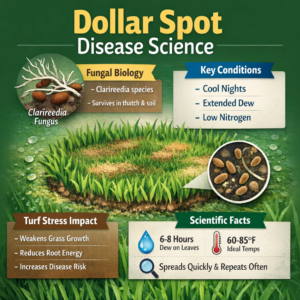
At its core, dollar spot disease science is rooted in fungal biology. The disease is caused by Clarireedia species, which survive in lawns as dormant fungal structures and active mycelium. These organisms persist in thatch, soil, and infected plant tissue even when symptoms are not visible — a survival strategy well documented in university turfgrass pathology research, including Purdue Extension studies on dollar spot disease.
When environmental conditions become favorable, the fungus resumes activity. Specifically, cool nights, warm days, and prolonged moisture on leaf surfaces allow fungal growth to accelerate. Unlike some lawn diseases, dollar spot does not require free-standing water. Instead, extended dew periods often provide sufficient moisture for infection.
As fungal growth increases, it disrupts normal leaf function and limits the plant’s ability to photosynthesize efficiently. Over time, this damage reduces energy available for grass root growth, which further weakens turf density and lowers the lawn’s natural ability to compete and recover.
Dollar Spot Disease Science: Why Turf Stress Causes Infection
Stressed turf is far more vulnerable than healthy, actively growing grass. Stress reduces a plant’s ability to defend itself, repair tissue, and outgrow disease pressure.
Low nitrogen levels play a critical role here. When nitrogen availability drops, grass growth slows, leaf tissue thins, and recovery capacity declines. As a result, the fungus gains an advantage. This explains why dollar spot outbreaks frequently follow periods of reduced fertilization or nutrient imbalance.
Additionally, mowing stress, compacted soils, and shallow root systems further limit turf resilience. When multiple stress factors combine, infection pressure increases rapidly.
Dollar Spot Disease Science and Moisture Behavior in Lawns
Moisture management is a central component of dollar spot disease science. Although the disease does not rely on saturated soil, it depends heavily on moisture retained on leaf surfaces. Similar moisture-driven dynamics are also observed with brown patch fungus, where extended leaf wetness creates ideal conditions for fungal growth and infection—unlike stress-driven diseases such as fusarium blight, which develop under very different environmental pressures.
Extended dew, high humidity, and poor airflow all increase the duration of leaf wetness. When leaves remain wet overnight, fungal spores germinate and penetrate plant tissue more effectively. Consequently, lawns with dense shade, restricted air movement, or excessive thatch experience higher disease pressure.
Importantly, irrigation timing also influences outcomes. Watering late in the day extends moisture duration, while morning irrigation allows leaves to dry more quickly. Over time, these patterns significantly affect disease frequency and severity.
Dollar Spot Disease Science: How the Disease Spreads
Dollar spot disease science also explains why the disease often appears in clusters and spreads outward. The fungus moves through direct contact between infected and healthy tissue. Mowing equipment, foot traffic, and even rainfall splash can transport fungal material across the lawn.
Because of this, small initial infections can expand rapidly when conditions remain favorable. The disease does not require large spores or airborne dispersal. Instead, routine lawn activity becomes a primary driver of spread.
As turf weakens, thinning areas create additional opportunities for the fungus to persist and re-infect the same locations season after season.
How Dollar Spot Disease Science Guides Long-Term Lawn Health
Ultimately, dollar spot disease science reinforces a broader principle in lawn management. Disease pressure increases when turf balance declines. Conversely, when grass maintains steady growth, strong roots, and proper moisture regulation, disease resistance improves naturally — a concept that aligns closely with professional lawn care resources focused on long-term turf health.
Rather than reacting to visible symptoms alone, science-based lawn care focuses on preventing the stress conditions that allow disease to thrive. When disease pressure exceeds the lawn’s natural defenses, professional fungus service becomes necessary to interrupt active infection and protect turf from further decline.
By understanding how dollar spot disease functions biologically, lawns can be managed in a way that reduces risk and supports consistent performance throughout the growing season.
Hear What Our Happy Customers Have to Say!
For a Limited Time
Get Started Today and Enjoy Our Special Offer: Free Grub Control, Free Aeration, Free Fungicide, and Free Turf-Damaging Insect Control! Plus, Save 10% When You Prepay!
Your Local Lawn Care Experts
Dallas-Fort Worth
Address
3333 Earhart Dr., Suite 200
Carrollton, TX 75006
Phone Number
1-800-465-2934
Ready to elevate your lawn care game?
Get a free quote today.