
How Lawn Fungus Spreads
Lawn fungus does not appear randomly. Instead, fungal diseases spread through predictable biological and environmental pathways. Understanding how lawn fungus spreads helps explain why outbreaks start suddenly, expand quickly, and often return under similar conditions year after year. These patterns are explored further in lawn fungus science, which explains how disease develops at the biological level.
Rather than focusing on visible symptoms alone, lawn care science examines moisture movement, turf stress, airflow, and root health. When these factors align, fungal pathogens gain the opportunity to grow, reproduce, and move across turfgrass.
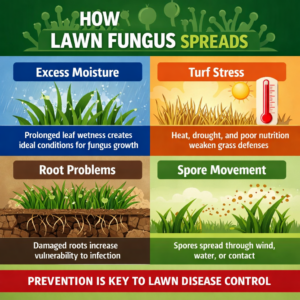
How Lawn Fungus Spreads Through Moisture and Leaf Wetness
Moisture plays the single most important role in fungal spread. Most lawn diseases require extended leaf wetness to activate and reproduce.
When grass blades remain wet from frequent irrigation, heavy dew, or rainfall, fungal spores germinate more easily. As a result, infection pressure increases even in otherwise healthy lawns. Water droplets also act as a transport system, allowing spores to move from blade to blade. University turfgrass research has consistently shown that prolonged leaf wetness and high humidity significantly increase lawn disease development.
Additionally, poor drainage keeps soil surfaces damp longer. This slows evaporation and creates ideal conditions for disease expansion. Because of this, lawns that stay wet overnight face a much higher risk of fungal spread, a pattern commonly seen with brown patch fungus during warm, humid periods.
How Lawn Fungus Spreads in Stressed or Weakened Turf
Healthy grass resists disease more effectively. However, when turf becomes stressed, fungal pathogens gain a competitive advantage.
Heat stress, drought stress, nutrient imbalance, and compaction all weaken natural defenses. As growth slows, grass struggles to repair damaged tissue. Consequently, fungi colonize leaf surfaces and crowns more easily.
This explains why lawn fungus often appears during summer stress periods or after sudden environmental changes. Stress does not cause fungus directly, but it removes the turf’s ability to defend itself, a pattern commonly associated with dollar spot disease in weakened turf.
How Lawn Fungus Spreads Through Poor Airflow and Density
Airflow strongly influences how long moisture remains on the turf surface. Dense lawns with limited circulation dry more slowly, especially in shaded or enclosed areas.
When air cannot move freely across grass blades, humidity builds near the canopy. Over time, this trapped moisture creates a stable environment for fungal growth. As a result, disease spreads outward from shaded zones into surrounding turf.
Improving airflow helps shorten leaf wetness periods. Therefore, airflow management plays a quiet but critical role in disease prevention.
How Lawn Fungus Spreads Below the Surface Through Roots
While symptoms appear above ground, fungal activity often begins below the surface. Root systems influence how well turf tolerates disease pressure.
Shallow or damaged roots reduce water and nutrient uptake. When roots struggle, grass becomes more vulnerable to infection. Certain diseases also spread through the crown and root zone, especially when soil remains warm and moist, a pattern commonly associated with fusarium blight in susceptible turf.
Because of this, lawns with compromised root development experience faster disease progression and slower recovery. Root health directly affects how lawn fungus spreads and persists.
How Lawn Fungus Spreads From Existing Infection Sites
Once fungus establishes in one area, it rarely stays isolated. Fungal spores move through mowing equipment, foot traffic, pets, wind, and splashing water.
Each activity increases the chance of transferring spores into healthy turf. Over time, small infection centers expand outward, forming visible rings, patches, or streaks.
This spread pattern explains why early-stage disease often goes unnoticed. By the time symptoms become obvious, fungal activity has already advanced beyond the initial site.
Why Understanding How Lawn Fungus Spreads Matters
Understanding how lawn fungus spreads shifts lawn care decisions from reactive to preventative. Instead of chasing symptoms, science-based programs focus on reducing the conditions that allow disease to thrive. This preventative mindset is central to professional fungicide service programs designed to interrupt disease before visible damage escalates.
Balanced moisture, reduced stress, improved airflow, and strong root development work together to limit fungal pressure. As these conditions improve, outbreaks become less frequent and less severe. These principles align closely with modern lawn care resources that emphasize long-term turf health over short-term corrections.
At Dr. Green Services, lawn disease management follows this biological approach. By addressing the factors that influence fungal spread, lawns develop stronger natural resistance and maintain healthier growth over time.
Hear What Our Happy Customers Have to Say!
For a Limited Time
Get Started Today and Enjoy Our Special Offer: Free Grub Control, Free Aeration, Free Fungicide, and Free Turf-Damaging Insect Control! Plus, Save 10% When You Prepay!
Your Local Lawn Care Experts
Dallas-Fort Worth
Address
3333 Earhart Dr., Suite 200
Carrollton, TX 75006
Phone Number
1-800-465-2934
Ready to elevate your lawn care game?
Get a free quote today.