
Tree and Shrub Nutrient Science
Tree nutrient science explains how trees and shrubs absorb, store, and use essential nutrients over time. As part of broader tree and shrub science, this approach focuses on long-term biological processes rather than quick visual changes, which provides a more accurate framework for understanding plant health.
Unlike turfgrass, woody plants store nutrients across multiple seasons. As a result, they respond slowly to change and rely heavily on internal reserves. Therefore, proper nutrition depends on timing, balance, and root function—key principles explored throughout tree and shrub science.
This page explains how nutrients move through trees and shrubs, why growth cycles matter, and how nutrition supports stability, resilience, and longevity within a science-based tree and shrub care framework.
Tree Nutrient Science and How Trees Absorb Nutrients
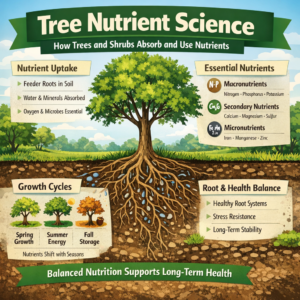
To begin with, nutrient uptake occurs primarily below ground. Trees and shrubs absorb nutrients through fine feeder roots located near the soil surface. These roots depend on moisture, oxygen, and biological activity to function efficiently. Research on tree root systems and nutrient uptake from the USDA Forest Service highlights how these fine roots drive long-term nutrient absorption and storage in woody plants.
As water moves through the soil, dissolved nutrients travel toward roots through mass flow and diffusion. Once absorbed, nutrients enter the vascular system and move upward to support growth, energy storage, and tissue repair. However, when soil structure is compacted or moisture becomes inconsistent, uptake efficiency declines—even if nutrients are present.
Essential Nutrients in Tree Nutrient Science
From a biological standpoint, nutrients fall into three primary categories that influence woody plant health:
-
Macronutrients, such as nitrogen, phosphorus, and potassium, support growth, root strength, and energy transfer
-
Secondary nutrients, including calcium, magnesium, and sulfur, help regulate cell structure and metabolic activity
-
Micronutrients, like iron, manganese, and zinc, support enzyme function and chlorophyll production
Importantly, trees require these nutrients in specific ratios. Consequently, excess levels of one nutrient can limit the uptake of others. Therefore, balance matters far more than application volume.
Tree Nutrient Science and Seasonal Growth Cycles
Growth does not occur randomly. Instead, tree nutrient science shows that nutrient demand shifts throughout the year as internal priorities change.
Early in the growing cycle, nutrients support leaf expansion and root development. Meanwhile, mid-season nutrition maintains canopy function and energy production. Later in the season, however, trees redirect nutrients into storage tissues rather than new growth. Because of this pattern, nutrient availability must align with biological timing rather than calendar assumptions.
Root Health and Nutrient Uptake in Trees and Shrubs
Equally important, root health determines how effectively nutrients are used. Roots require oxygen, stable soil structure, and balanced moisture to function properly.
When soils become compacted or waterlogged, oxygen levels drop. As a result, nutrient movement slows and absorption efficiency declines. Over time, stressed root systems reduce a tree’s ability to distribute nutrients internally, even in nutrient-rich soils.
Tree Nutrient Science and Stress Response
Trees regularly experience stress from drought, heat, insects, disease, and environmental disruption. In these situations, nutrition plays a supportive—but carefully regulated—role.
Balanced nutrients help maintain cell integrity, regulate water movement, and preserve energy reserves. However, excessive nitrogen during stress periods can backfire. For example, it may stimulate soft growth that increases water demand and vulnerability. Therefore, nutrition should reinforce resilience rather than force growth.
Shrub Nutrition Compared to Tree Nutrient Science
Although shrubs share many nutritional requirements with trees, they often respond more quickly to changes. This difference occurs because shrubs have smaller root systems and shorter lifespans.
As a result, shrubs depend more on consistent nutrient availability than long-term storage. Consequently, timing and distribution become especially important for maintaining density, flowering, and structural integrity.
Why Tree Nutrient Science Emphasizes Balance Over Speed
Ultimately, woody plants adapt slowly. Tree nutrient science consistently shows that stability matters more than rapid visual improvement.
Effective nutrition supports:
-
Structural strength
-
Root system expansion
-
Energy storage
-
Resistance to environmental stress
Therefore, when nutrients are applied thoughtfully and in balance, trees and shrubs develop stronger systems that perform reliably year after year.
Long-Term Tree and Shrub Health Through Nutrient Science
Finally, surface symptoms rarely tell the full story. Yellowing leaves, thinning canopies, or reduced growth often reflect underlying nutrient movement or root function issues rather than simple deficiencies—concerns that are commonly addressed through professional tree and shrub care services guided by plant biology rather than guesswork.
When nutrient science guides care decisions, trees and shrubs develop more predictable growth patterns, improved stress tolerance, and greater longevity. In the long run, nutrition becomes a stabilizing system rather than a reactive solution, especially when supported by broader lawn care resources that help homeowners understand how soil conditions and landscape practices influence plant health.
Hear What Our Happy Customers Have to Say!
For a Limited Time
Get Started Today and Enjoy Our Special Offer: Free Grub Control, Free Aeration, Free Fungicide, and Free Turf-Damaging Insect Control! Plus, Save 10% When You Prepay!
Your Local Lawn Care Experts
Dallas-Fort Worth
Address
3333 Earhart Dr., Suite 200
Carrollton, TX 75006
Phone Number
1-800-465-2934
Ready to elevate your lawn care game?
Get a free quote today.