
Seasonal Mosquito Activity and Why It Changes Throughout the Year
Seasonal mosquito activity follows predictable biological patterns shaped by temperature, moisture, and environmental stability. Understanding seasonal mosquito activity helps explain why mosquito populations rise and fall throughout the year rather than appearing at random.
These seasonal shifts are closely connected to broader environmental conditions, including moisture management, vegetation density, and soil health, which are explored further in our Lawn Care Science resources. They also align with the biological principles outlined in Mosquito Control Science, where mosquito development, reproduction, and survival are driven by climate and habitat rather than calendar dates.
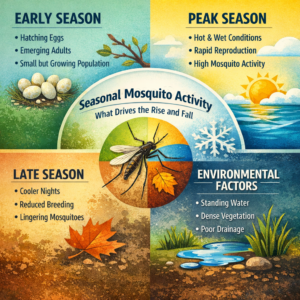
What Drives Mosquito Activity by Season
Seasonal mosquito activity is controlled by temperature, water availability, and daylight length. These factors regulate how quickly mosquitoes develop, how often they reproduce, and how long they survive throughout the year, as outlined in the EPA’s overview of the mosquito life cycle.
Because mosquitoes are cold-blooded, warmer conditions speed up their metabolism. Eggs hatch faster, larvae develop more quickly, and adults bite more often. Moisture creates breeding sites, while daylight cues activity levels and reproduction. Together, these forces drive the annual rhythm of mosquito populations.
Early-Season Mosquito Population Patterns
Mosquito activity often begins as soon as temperatures consistently rise above freezing. Overwintering eggs hatch, and dormant adults emerge and start seeking hosts.
Early-season populations start small but carry strong biological momentum. Limited predators, abundant moisture, and minimal competition allow mosquitoes to reproduce quickly. As a result, early generations establish the base for much larger populations later in the year.
Peak Seasonal Mosquito Activity Explained
Peak seasonal mosquito activity occurs during prolonged warm weather combined with repeated moisture. These conditions allow mosquito life cycles to shorten dramatically.
During peak periods, reproduction overlaps across generations, feeding frequency increases, and population growth accelerates. This exponential expansion explains why mosquito pressure often appears suddenly rather than gradually. Increased density during this phase also raises disease risk due to more frequent human biting events.
Late-Season Mosquito Activity and Decline
Mosquito populations do not disappear when summer ends. Instead, activity tapers as environmental conditions shift.
Shorter days and cooler nights slow development and limit egg production. Some species enter overwintering states, while others stay active during warm spells. Sheltered environments continue to support survival into fall, which explains why mosquito pressure often lingers longer than expected.
How Seasonal Mosquito Activity Varies by Species
Seasonal mosquito activity differs significantly by species. Some mosquitoes emerge early, peak quickly, and decline as conditions dry out. Others adapt well to residential environments and remain active later into the season.
These biological differences help explain why mosquito pressure varies between neighborhoods and why certain species are more closely linked to human disease risk.
Environmental Factors That Extend Mosquito Activity
Human-managed environments can unintentionally extend mosquito activity beyond natural limits. Conditions that retain moisture and reduce airflow create stable habitats that support survival even when weather becomes less favorable.
Common factors that prolong mosquito presence include:
-
Standing water near homes
-
Overwatered lawns and irrigation patterns
-
Dense vegetation and shaded areas
-
Poor drainage and compacted soil
When these conditions persist, mosquito populations may remain active longer, increasing late-season exposure.
Why Seasonal Mosquito Activity Matters
Seasonal mosquito activity explains why reactive approaches often fail and why professional mosquito control focuses on early intervention. By the time mosquitoes become noticeable, populations are usually already established.
When prevention aligns with mosquito biology and seasonal development patterns, proactive measures like mosquito barrier treatments can target activity earlier rather than responding after populations peak. This science-based timing leads to more consistent and sustainable outcomes.
Seasonal Mosquito Activity and Long-Term Risk
Seasonal mosquito activity influences more than short-term nuisance levels. It affects disease potential, neighborhood-wide exposure, and population carryover from one year to the next, which is why a comprehensive mosquito control service focuses on prevention rather than reaction.
Periods of peak activity increase the likelihood of repeated biting and sustained transmission cycles. Understanding these seasonal patterns also connects closely to moisture management, vegetation density, and environmental conditions addressed in broader lawn care resources, supporting informed decisions that reduce risk before it escalates.
Hear What Our Happy Customers Have to Say!
For a Limited Time
Get Started Today and Enjoy Our Special Offer: Free Grub Control, Free Aeration, Free Fungicide, and Free Turf-Damaging Insect Control! Plus, Save 10% When You Prepay!
Your Local Lawn Care Experts
Dallas-Fort Worth
Address
3333 Earhart Dr., Suite 200
Carrollton, TX 75006
Phone Number
1-800-465-2934
Ready to elevate your lawn care game?
Get a free quote today.