
How Mosquitoes Spread Disease
Mosquitoes are not just irritating pests. They are biological vectors that can transmit viruses and parasites through blood feeding. Understanding mosquito disease spread means looking at the mosquito’s feeding tools, its saliva, and what happens to pathogens inside the insect before they ever reach a person. This type of biological understanding is a core part of mosquito control science and explains why surface-level solutions often fall short.
This page breaks down the science behind transmission in a clear way, so homeowners understand why prevention matters and what actually increases risk. When combined with broader lawn care science, this knowledge helps explain how seasonal and environmental conditions around the home influence mosquito activity and exposure.
What Mosquito Disease Spread Means
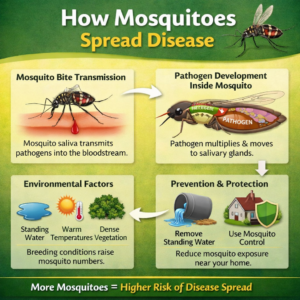
Mosquito disease spread is the biological transfer of a pathogen from one host to another through a mosquito’s bite. This is not surface contamination and not “dirtiness.” As explained by the CDC, mosquitoes transmit pathogens through saliva released during feeding, not through contact with blood alone. The pathogen must survive inside the mosquito and reach the salivary glands before the mosquito becomes capable of infecting another host.
That is why disease risk tends to rise in predictable patterns when mosquito populations increase and biting activity becomes more frequent.
How Mosquito Bites Transmit Infection
When a mosquito bites, it does not simply “draw blood.” It uses a thin mouthpart called a proboscis to locate blood vessels and then releases saliva to keep blood from clotting. If the mosquito is infectious, pathogens can be present in that saliva and enter the body during feeding.
This salivary exchange is the core mechanism behind transmission, and it explains why even brief bites can matter.
Mosquito Disease Spread Starts Inside the Mosquito
For transmission to occur, a mosquito must first bite an infected host. The pathogen then enters the mosquito and must survive digestion. If it survives, it replicates and migrates through the mosquito’s body to the salivary glands.
Only after this internal process is complete can the mosquito spread infection to another host. This time delay is one reason outbreaks often lag behind changes in weather and mosquito population growth.
Why Some Species Drive Mosquito Disease Spread
Not all mosquito species pose the same risk. Some prefer birds or mammals and rarely bite humans. Others thrive near people, feed more often, and are better adapted to residential life, which makes them more susceptible to control through mosquito barrier treatments.
Species that live close to homes, bite aggressively, and reproduce quickly are more likely to drive mosquito disease spread because they increase the number of human biting events across a neighborhood. Because other pests can also contribute to disease risk near structures, perimeter pest treatments help reduce overall exposure by limiting pest activity before it reaches living spaces.
Environmental Conditions That Increase Mosquito Disease Spread
Disease risk rises when conditions help mosquitoes breed, survive, and feed consistently. Warm temperatures speed mosquito development and can shorten the time it takes a pathogen to become transmissible inside the mosquito.
Common residential factors that increase risk include:
-
Standing water that persists for several days
-
Warm, humid stretches of weather
-
Dense shade and thick vegetation that protect mosquitoes from drying out
-
Poor drainage that creates recurring puddling
When these conditions stack up, mosquito pressure rises and exposure becomes more likely.
Key Takeaways for Homeowners
Most exposure happens close to home because mosquitoes often breed nearby and remain within a limited range. That is why prevention is more effective than reacting after bites become constant. Practical lawn care resources help homeowners understand how drainage, turf conditions, and moisture management influence mosquito activity around the home.
The most important point is simple: mosquito disease spread is driven by biology and environment. When mosquito activity rises, risk rises too—often before anyone notices symptoms or connects the dots. In these situations, a professional mosquito control service focuses on reducing mosquito pressure before exposure becomes a larger concern. To apply these science-based principles consistently across the season, mosquito control service programs focus on timing, habitat management, and targeted treatments designed to reduce mosquito pressure effectively.
Hear What Our Happy Customers Have to Say!
For a Limited Time
Get Started Today and Enjoy Our Special Offer: Free Grub Control, Free Aeration, Free Fungicide, and Free Turf-Damaging Insect Control! Plus, Save 10% When You Prepay!
Your Local Lawn Care Experts
Dallas-Fort Worth
Address
3333 Earhart Dr., Suite 200
Carrollton, TX 75006
Phone Number
1-800-465-2934
Ready to elevate your lawn care game?
Get a free quote today.