
How Perimeter Pest Treatments Stop Pests
Perimeter pest treatments work by disrupting how insects move and approach structures. Because they target exterior travel paths, they stop common pests before insects reach entry points and establish indoor activity—an approach rooted in exterior pest control science that emphasizes prevention over reaction.
Instead of reacting after pests appear indoors, this science-based approach focuses on prevention at the structure’s outer boundary. As a result, pest biology, movement behavior, and environmental conditions—principles also explored in mosquito control science—work together to limit infestations before they begin.
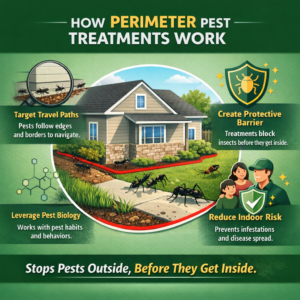
How Perimeter Pest Treatments Intercept Pest Movement
Most crawling insects do not move randomly across open areas. Instead, they follow physical edges such as foundation walls, siding seams, mulch borders, and shaded transitions because these features provide orientation and protection. This behavior aligns with integrated pest management principles that focus on intercepting pests along predictable movement paths.
Therefore, when treatments are placed along these routes, pests encounter barriers during normal movement. As exposure occurs, mobility and recovery decline, which prevents insects from continuing toward doors, windows, and structural openings.
Why Pests Naturally Follow Structural Perimeters
Exterior structures create favorable microenvironments for insects. For example, foundations retain warmth, shaded walls reduce environmental stress, and moisture often collects near the base of buildings—conditions that strongly influence seasonal pest activity around homes.
Because of this, many pests instinctively move along vertical and horizontal edges while searching for food or shelter. Ants, spiders, and other crawling insects rely on these perimeters for navigation, which explains why exterior-focused strategies remain so effective.
How Perimeter Pest Treatments Disrupt Pest Behavior
Rather than acting only on contact, perimeter pest treatments alter how pests interact with treated surfaces over time. As exposure increases, nerve signaling and coordination become less reliable.
Consequently, even insects that are not immediately eliminated may struggle to forage or return to nesting areas. Over time, repeated exposure reduces pest pressure around the structure, making sustained activity increasingly difficult.
Surface Contact and Perimeter Pest Treatments
Most pests spend the majority of their life cycle moving across surfaces, not flying through open air. Therefore, surface contact plays a critical role in exterior pest control.
Key contact zones include:
-
Foundation walls and base trim
-
Soil and mulch transitions
-
Entry thresholds and expansion joints
-
Shaded siding and utility penetrations
By focusing on these areas, perimeter pest treatments place control directly where pests naturally travel. This same surface-contact principle is used in mosquito barrier treatments, which focus on treating foliage and shaded resting areas where mosquitoes naturally land during normal activity.
Why Perimeter Pest Treatments Reduce Indoor Infestations
Indoor infestations typically begin outdoors. When exterior populations increase, insects eventually exploit small cracks and gaps to move inside.
However, when pest activity declines around the structure, the pressure driving indoor entry also drops. As a result, perimeter-based control significantly lowers the likelihood of indoor infestations forming in the first place. This reduction in exterior pest pressure also plays an important role in limiting mosquito disease spread, since most exposure occurs close to structures where mosquitoes rest, feed, and repeatedly interact with people.
Environmental Factors That Influence Treatment Effectiveness
Pest movement responds strongly to environmental conditions. For instance, temperature, moisture, and shelter availability all influence where insects concentrate along structures, including the pathways that affect fleas and pets.
Therefore, shaded areas and moisture-prone zones often require closer attention, particularly because these same conditions also contribute to ticks and disease. When perimeter pest treatments account for these factors, results remain more consistent across seasons and changing conditions.
Perimeter Pest Treatments vs Interior Pest Control
Interior pest control focuses on visible activity after pests enter a structure. While this may provide short-term relief, it does not address the source of the problem.
In contrast, perimeter-based strategies focus on prevention. By controlling pests where they originate and travel, this approach reduces the need for repeated indoor intervention and supports long-term stability.
Why Perimeter Pest Treatments Are a Science-Based Strategy
Ultimately, perimeter pest treatments succeed because they are grounded in pest biology and behavior. By leveraging known movement patterns, surface contact habits, and environmental preferences, this strategy interrupts pest activity before it escalates—principles that guide both exterior pest control services and professional mosquito control services when applied in real-world environments.
As a result, perimeter-focused control remains one of the most reliable tools in exterior pest control science and a foundational component of prevention-based pest management. These same biological concepts also connect closely with broader lawn care resources, where moisture, shelter, and vegetation management influence pest pressure around structures.
Hear What Our Happy Customers Have to Say!
For a Limited Time
Get Started Today and Enjoy Our Special Offer: Free Grub Control, Free Aeration, Free Fungicide, and Free Turf-Damaging Insect Control! Plus, Save 10% When You Prepay!
Your Local Lawn Care Experts
Dallas-Fort Worth
Address
3333 Earhart Dr., Suite 200
Carrollton, TX 75006
Phone Number
1-800-465-2934
Ready to elevate your lawn care game?
Get a free quote today.