
How Ticks Spread Disease Through Outdoor Habitats
Ticks are more than a seasonal nuisance. They are biological vectors capable of transmitting pathogens to humans and pets. Understanding tick disease spread requires looking beyond the tick itself and examining the outdoor environments that support tick survival, movement, and host contact—a concept also central to Mosquito Control Science and Exterior Pest Control Science.
This page explores how ticks transmit disease, why outdoor habitats play a central role, and how environmental conditions around homes influence exposure risk.
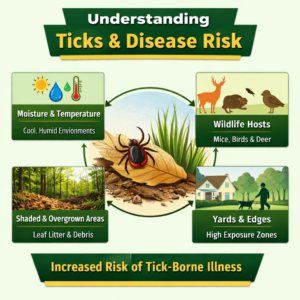
Understanding Tick Disease Spread
Tick disease spread begins when ticks acquire pathogens from infected wildlife hosts and later transmit those pathogens during feeding, a process well documented in CDC tick-borne disease research. Because ticks attach for long periods, they create extended opportunities for disease transmission.
Unlike insects that bite and leave quickly, ticks remain embedded in the skin. As a result, pathogens have time to move from the tick into the host. However, this process only succeeds when ticks survive long enough to find suitable hosts, which makes habitat conditions critical.
Therefore, disease risk depends as much on the environment as it does on the tick itself.
Outdoor Habitats That Drive Tick Disease Spread
Outdoor habitats determine where ticks survive and where disease risk concentrates. Ticks require moisture, shade, and protection from temperature extremes. Consequently, they thrive in areas that remain cool and humid for extended periods.
Shaded lawn edges, wooded borders, and unmanaged vegetation provide ideal shelter. In addition, leaf litter and organic debris trap moisture near the soil surface. Together, these conditions allow ticks to remain active and positioned along wildlife travel routes—patterns also observed in many outdoor crawling pests that depend on similar environmental cues.
When people or pets move through these habitats, exposure risk rises sharply.
Why Wildlife Influences Tick Disease Spread
Wildlife plays a central role in tick disease spread by supporting tick development and transporting ticks across properties. Small mammals, birds, and deer all contribute by serving as blood meal hosts—a role they also play in supporting fleas that depend on the same wildlife populations.
Rodents are especially important because they often carry pathogens without becoming sick. When young ticks feed on infected rodents, they acquire bacteria that can later be transmitted to humans. As wildlife moves through yards and green spaces, it deposits ticks in predictable locations.
As a result, disease risk often increases along property edges and transition zones rather than in open areas.
Tick Life Cycle and Disease Transmission Risk
Tick disease spread closely follows the tick life cycle. Ticks progress through multiple stages and require a blood meal at each stage to survive, a pattern that aligns with broader seasonal pest activity driven by temperature and environmental conditions.
Nymphs present the greatest disease risk. They are small, difficult to detect, and active during warmer months when outdoor activity increases. Because people often fail to notice nymphs, these ticks remain attached longer, which increases transmission likelihood.
When environmental conditions allow multiple life stages to overlap, disease pressure intensifies.
How Moisture and Shade Increase Tick Disease Spread
Moisture strongly influences tick disease spread. Ticks cannot tolerate dry conditions for long periods. Instead, they seek environments that maintain consistent humidity.
Overwatered lawns, poor drainage, dense mulch, and shaded turf all create favorable microclimates. Consequently, these conditions extend tick survival and increase host encounters. When moisture and shade persist near living spaces, disease risk rises even if ticks remain difficult to spot.
Therefore, managing moisture becomes a critical prevention strategy.
Tick Disease Spread Near Homes
Most tick exposure occurs close to home rather than deep in natural areas. This pattern exists because ticks establish populations in transition zones where managed landscapes meet natural habitats.
These areas act as staging zones where ticks wait for passing hosts. Because human activity frequently overlaps with these spaces, encounters become more likely. As a result, tick activity often appears localized and persistent rather than evenly distributed across a property.
Understanding this behavior helps explain why exposure often feels sudden and why perimeter pest control is effective at limiting tick movement along exterior boundaries near structures.
Environmental Conditions That Support Tick Disease Spread
Because tick disease spread depends on habitat quality, prevention focuses on reducing environmental support rather than reacting to bites alone. By altering outdoor conditions, homeowners can limit tick survival and movement.
Effective strategies include:
-
Reducing dense vegetation near turf
-
Managing excess moisture and drainage
-
Limiting leaf litter and organic debris
-
Creating separation between lawns and wooded areas
When habitats become less favorable, tick populations decline naturally over time.
Why Tick Disease Spread Follows Predictable Patterns
Tick disease spread follows biological rules. Ticks respond directly to moisture, temperature, shelter, and host availability. When these factors align, populations grow. When they do not, populations decline.
Because of this predictability, science-based exterior pest control emphasizes environmental awareness and prevention, working alongside broader lawn care resources that influence habitat conditions. By understanding how outdoor habitats shape tick behavior, long-term disease risk can be reduced more consistently.
This ecological approach provides more reliable protection for people and pets than short-term reaction alone.
Hear What Our Happy Customers Have to Say!
For a Limited Time
Get Started Today and Enjoy Our Special Offer: Free Grub Control, Free Aeration, Free Fungicide, and Free Turf-Damaging Insect Control! Plus, Save 10% When You Prepay!
Your Local Lawn Care Experts
Dallas-Fort Worth
Address
3333 Earhart Dr., Suite 200
Carrollton, TX 75006
Phone Number
1-800-465-2934
Ready to elevate your lawn care game?
Get a free quote today.