
Common Outdoor Crawling Pests Around Homes
Outdoor crawling pests are among the most common insects found around residential properties. Although they often go unnoticed at first, their activity follows clear biological patterns shaped by moisture, shelter, food availability, and seasonal conditions. These same environmental drivers also influence mosquito behavior and broader exterior pest activity, which explains why different pest pressures often overlap around homes.
By understanding how crawling insects behave outdoors, it becomes easier to explain why they appear near homes, how they move along exterior surfaces, and what allows their populations to persist over time. This science-based perspective aligns closely with modern mosquito control science and exterior pest control science, where prevention focuses on habitat conditions rather than reactive treatment.
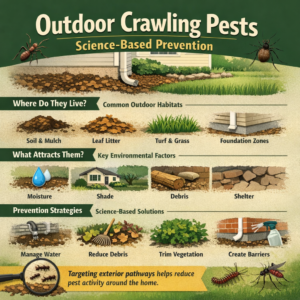
How Outdoor Crawling Pests Interact With Home Exteriors
In most cases, outdoor crawling pests do not originate indoors. Instead, they live in soil, mulch, turf, leaf litter, and foundation zones where temperature and humidity remain relatively stable. However, homes unintentionally create ideal transition areas between natural and built environments. Research from the Environmental Protection Agency highlights how pest activity near structures can increase human exposure and related public health concerns, especially when insects remain concentrated around living spaces.
For example, foundations retain warmth, siding creates shade, and landscaping holds moisture. Consequently, crawling insects naturally gravitate toward exterior walls, structural seams, and sheltered edges. Because they rely on surface movement rather than flight, their activity often concentrates along predictable pathways.
Common Outdoor Crawling Pests Found Near Homes
Although many insects exist outdoors, only a smaller group consistently adapts to residential environments. These include ants, fleas, ticks, spiders, certain outdoor cockroach species, earwigs, centipedes, and millipedes.
Despite their differences, these pests share similar environmental needs. Most depend on exterior moisture, shelter, and protected travel routes. Therefore, when conditions remain favorable, activity tends to persist near structures rather than dispersing naturally.
Why Outdoor Crawling Pests Thrive Near Foundations
Foundations function as ecological borders where soil, structure, and moisture meet. As a result, they provide shelter, moderated temperatures, and reduced environmental stress. For many crawling insects, this combination supports long-term survival.
Additionally, cracks, expansion joints, utility penetrations, and landscaping edges create protected movement corridors. Even when insects do not enter a structure, they may remain active along the perimeter because these areas consistently meet their habitat needs.
Moisture’s Role in Outdoor Crawling Pest Activity
Moisture remains one of the strongest drivers of crawling insect activity outdoors. Many species cannot regulate water loss efficiently. Therefore, moisture patterns that shift throughout the year play a major role in seasonal pest activity around homes.
Overwatering, poor drainage, dense mulch, and shaded turf increase moisture retention near foundations. Consequently, these conditions support insect development and extend seasonal activity. The same moisture-rich environments also support mosquito breeding, which helps explain how unmanaged exterior conditions can contribute to mosquito disease spread near homes. Over time, stable moisture allows populations to persist rather than decline naturally.
Seasonal Patterns of Outdoor Crawling Pests
Seasonal changes strongly influence crawling insect behavior. In spring, warming soil increases activity. During summer, populations stabilize in shaded and damp areas. As temperatures decline in fall, many insects shift closer to foundations for shelter.
Although winter slows activity, protected exterior zones can support overwintering pests. Because these transitions occur gradually, pressure often builds before homeowners notice visible signs.
Why Identification Improves Prevention Outcomes
Correct identification plays a critical role in effective prevention. Not all crawling insects behave the same way or respond to environmental changes equally.
Some species follow food sources, while others seek moisture or shelter. Some spread rapidly, whereas others persist quietly at low levels. Therefore, understanding these differences allows prevention strategies to focus on underlying causes rather than surface symptoms.
Science-Based Prevention for Outdoor Crawling Pests
Effective prevention emphasizes habitat disruption rather than individual insect removal. Science-based strategies typically focus on:
-
Managing moisture near foundations
-
Reducing debris and dense organic cover
-
Limiting sheltered harborage zones
-
Creating consistent exterior barrier zones
Because crawling insects follow predictable surface routes, prevention works best when applied where movement naturally occurs rather than where pests are eventually noticed. This is why perimeter-focused pest control plays a critical role in reducing crawling insect activity before populations become established near living spaces.
Outdoor Crawling Pests Within Exterior Pest Control Science
Outdoor crawling pests are a normal part of exterior ecosystems. However, their concentration near homes often results from environmental conditions shaped by construction and ongoing property maintenance, including lawn care practices that influence moisture, vegetation density, and shelter availability.
Ultimately, when insect biology, movement behavior, and habitat needs are understood, exterior pest control becomes more consistent and predictable. In the same way, this science-based understanding also supports professional mosquito control, since both crawling insects and mosquitoes respond to overlapping environmental conditions. As a result, effective approaches prioritize prevention, environmental awareness, and long-term population reduction rather than short-term reaction.
Hear What Our Happy Customers Have to Say!
For a Limited Time
Get Started Today and Enjoy Our Special Offer: Free Grub Control, Free Aeration, Free Fungicide, and Free Turf-Damaging Insect Control! Plus, Save 10% When You Prepay!
Ready to elevate your lawn care game?
Get a free quote today.