
Why Lawns Thin Over Time
Why lawns thin over time often has little to do with mowing or watering and much more to do with what happens below the surface. Lawn care science shows that turf density depends on healthy roots, balanced soil conditions, and the ability of grass to recover from stress. When these systems weaken, lawns slowly lose thickness even if they still look green for part of the season.
Most thinning lawns decline gradually. Instead of failing all at once, grass loses density year after year as stress accumulates and recovery slows. Understanding the science behind this process explains why surface-level fixes rarely solve the problem long term.
Root Health Is the Foundation of a Thick Lawn
Grass thickness begins with roots. Healthy turf produces dense growth when roots grow deep, spread evenly, and absorb water and nutrients efficiently. However, roots respond directly to soil conditions and environmental stress. Grass root growth science explains how root depth and structure directly influence turf density and long-term lawn health.
Over time, compacted soil limits oxygen flow and restricts root expansion. As a result, roots stay shallow and fragile. Shallow roots dry out faster, struggle in heat, and cannot support thick grass blades. When roots weaken year after year, lawns thin over time—even if the surface still looks green for a while.
Soil Compaction Is a Major Reason Why Lawns Thin Over Time
Soil compaction is one of the most common and overlooked reasons why lawns thin out. Foot traffic, mowing equipment, pets, and natural settling all press soil particles together. This reduces pore space in the soil. Aeration science explains how improving soil structure allows oxygen and water to reach roots more effectively, which supports thicker and healthier turf over time.
When soil compacts:
-
Water struggles to move evenly
-
Oxygen cannot reach roots efficiently
-
Roots grow sideways instead of deep
Because grass relies on oxygen and moisture exchange, compacted soil gradually suffocates turf from below. Over time, thinning becomes unavoidable without correcting the underlying soil structure. University turfgrass research on root growth and density shows that compacted soil restricts oxygen movement and root development, which directly contributes to thinning turf over time.
Nutrient Imbalances Explain Why Lawns Thin Over Time
Grass needs consistent access to nutrients to maintain density. Nitrogen supports blade growth and color, while potassium strengthens stress tolerance and root function. When nutrients become unbalanced—or applied incorrectly—grass growth slows. Fertilizer science shows how balanced nutrient programs support grass recovery and help lawns maintain thickness over time.
Lawn care science shows that repeated stress without proper nutrition forces grass to conserve energy. Instead of spreading and thickening, turf focuses on survival. As a result, bare areas appear, and lawns thin over time rather than improving.
Environmental Stress Builds and Causes Lawns to Thin Over Time
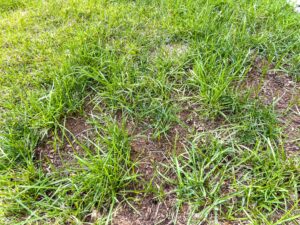
Heat, drought, cold, and heavy use all stress turf. While grass can recover from short-term stress, repeated exposure without proper support causes long-term decline.
Each season of stress compounds the next:
-
Summer heat weakens roots
-
Fall recovery becomes limited
-
Winter damage sets turf back further
Without intervention, lawns thin over time gradually instead of all at once. This slow decline often confuses homeowners because the damage builds quietly year after year.
Poor Recovery Is Another Reason Why Lawns Thin Over Time
Healthy lawns constantly recover. Grass spreads laterally, fills gaps, and replaces damaged blades. However, when roots remain weak and soil stays compacted, recovery slows dramatically.
Instead of thickening, turf becomes patchy. Weeds often exploit these thin areas, making the lawn look even worse. Lawn care science identifies recovery failure as a key reason why lawns thin over time.
Why Lawns Thin Over Time Requires a Science-Based Solution
Lawns do not thin randomly. They thin because biological systems lose efficiency over time. Root stress, compacted soil, nutrient imbalance, and repeated environmental pressure all contribute to gradual turf decline.
At Dr. Green Services, lawn care focuses on correcting the reasons why lawns thin over time—not masking surface symptoms. A professional lawn care service strengthens roots, improves soil function, and supports long-term recovery so grass can thicken naturally. For homeowners who want to explore related topics in more depth, our lawn care resources offer additional science-based guides on turf health and lawn care.
Hear What Our Happy Customers Have to Say!
For a Limited Time
Get Started Today and Enjoy Our Special Offer: Free Grub Control, Free Aeration, Free Fungicide, and Free Turf-Damaging Insect Control! Plus, Save 10% When You Prepay!
Your Local Lawn Care Experts
Dallas-Fort Worth
Address
3333 Earhart Dr., Suite 200
Carrollton, TX 75006
Phone Number
1-800-465-2934
Ready to elevate your lawn care game?
Get a free quote today.