
Lawn Aeration Science
Healthy lawns depend on more than water and fertilizer alone. Instead, lawn aeration science explains how soil structure, oxygen flow, and root access work together to support strong turf. Over time, when soil becomes compacted, roots struggle to breathe, absorb nutrients, and grow deeply. Because of this, aeration restores balance in the soil, which helps grass grow thicker, recover faster, and remain healthier over the long term.
What Is Lawn Aeration and Why It Matters
Lawn aeration is the process of relieving soil compaction to improve air, water, and nutrient movement into the root zone. Over time, everyday factors such as foot traffic, mowing equipment, rainfall, and natural settling press soil particles together. As this happens, vital pore space gradually disappears.
As a result of compaction:
-
Oxygen cannot reach roots
-
Water runs off instead of soaking in
-
Nutrients remain trapped near the surface
Because these issues limit root function, aeration plays a critical role in restoring healthy soil conditions. Lawn seeding science shows that reducing compaction through aeration improves seed-to-soil contact, increases oxygen availability, and allows new grass roots to establish more quickly.
Lawn Aeration Science and Soil Compaction
Soil naturally contains solids, water, and air. Under healthy conditions, these elements remain in balance. However, when compaction occurs, soil contains too many solids and not enough air space. Because roots depend on oxygen and pore space to grow properly, this imbalance helps explain why lawns thin over time.
As compaction increases:
-
Root growth becomes shallow
-
Microbial activity slows
-
Nutrient uptake efficiency drops
For this reason, lawn aeration science focuses on restoring soil porosity. Once pores reopen, oxygen exchange improves. At the same time, beneficial soil biology becomes active again. Consequently, roots regain their ability to grow and function efficiently. For a deeper look at how soil structure, root health, and long-term turf performance work together, lawn aeration fits directly within the broader principles of lawn care science.
Why Oxygen Flow Matters in Lawn Aeration Science
Grass roots require oxygen for respiration. In turn, this process supports energy production, nutrient absorption, and cellular repair. When oxygen levels decline due to compaction, roots weaken even if water and fertilizer are present.
With proper lawn aeration:
-
Oxygen diffusion improves
-
Root systems grow deeper
-
Stress tolerance increases
As a result, turf becomes more resilient to heat, drought, and seasonal stress. When soil conditions improve, grub control science ensures roots stay intact and able to take advantage of better airflow and moisture.
How Lawn Aeration Improves Water and Nutrient Movement

Compacted soil often repels water rather than absorbing it. Consequently, this leads to runoff, puddling, and uneven moisture distribution. In addition, nutrients applied at the surface may remain unavailable to roots.
Lawn aeration improves this process by:
-
Allowing water to penetrate evenly
-
Moving nutrients into the root zone
-
Reducing surface evaporation
Because of these improvements, irrigation and fertilization become more efficient across the lawn. Lawn aeration works best when it is part of a well-timed, season-based lawn care approach, which aligns with recommendations from university extension programs such as Penn State Extension. Because nutrients move more efficiently through aerated soil, fertilization becomes more effective when applied using the principles outlined in lawn fertilizer science.
Lawn Aeration and Root Development
Root depth directly affects turf strength. For example, shallow roots dry out faster, experience heat stress sooner, and recover more slowly from damage.
By reducing compaction, lawn aeration:
-
Encourages deeper root growth
-
Improves anchoring and stability
-
Supports thicker turf coverage
In addition, stronger root systems help limit weed pressure by reducing open soil space. Stronger root systems and thicker turf also help limit weed pressure, which is a key focus of weed control science.
Lawn Aeration Science: Liquid Aeration vs Core Aeration
Lawn aeration science includes multiple methods, each affecting soil differently. Most commonly, lawns are treated using either core aeration or liquid aeration.
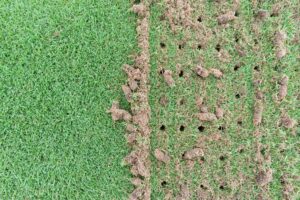
Core Aeration and Mechanical Soil Relief
Core aeration removes plugs of soil to reduce compaction mechanically. While this method can be effective, it:
-
Disrupts the soil surface
-
Leaves plugs behind
-
Targets a limited soil depth
Because of these factors, recovery time and surface disruption are common considerations.
Liquid Lawn Aeration and Soil Conditioning
Liquid aeration uses soil-conditioning solutions to loosen compacted particles at a microscopic level. As a result, this method:
-
Improves pore space without surface disruption
-
Enhances soil structure throughout the soil profile
-
Works well in heavily compacted areas
Ultimately, both methods aim to restore oxygen flow. However, they rely on different mechanisms to achieve that goal. While both approaches aim to relieve soil compaction, the differences between liquid aeration and core aeration become more important when evaluating effectiveness, surface disruption, and long-term results, which are explained in more detail in our comparison of liquid aeration vs core aeration.
Timing Factors in Lawn Aeration Science
Aeration effectiveness depends on grass type, climate, and soil condition. Generally, turf responds best when it is actively growing and capable of recovery.
Because timing matters, important considerations include:
-
Seasonal growth cycles
-
Soil moisture levels
-
Existing compaction severity
Therefore, understanding timing is an essential part of applying lawn aeration science correctly. As a result, understanding seasonal lawn growth cycles helps explain when aeration delivers the greatest benefit and when turf is best prepared to recover.
How Lawn Aeration Supports Overall Lawn Health
Aeration does not work in isolation. Instead, it enhances other lawn care practices by improving soil conditions first.
When soil health improves:
-
Fertilizers absorb more efficiently
-
Roots resist stress and disease
-
Turf maintains consistent color and density
Because of this, aeration serves as a foundational component of long-term lawn care.
Long-Term Benefits of Lawn Aeration Science
Healthy soil forms the base of every successful lawn. Ultimately, lawn aeration science shows that restoring oxygen flow, water movement, and root access leads to stronger turf over time. By addressing compaction at its source, aeration supports sustainable growth rather than short-term surface improvement.
Hear What Our Happy Customers Have to Say!
For a Limited Time
Get Started Today and Enjoy Our Special Offer: Free Grub Control, Free Aeration, Free Fungicide, and Free Turf-Damaging Insect Control! Plus, Save 10% When You Prepay!
Your Local Lawn Care Experts
Dallas-Fort Worth
Address
3333 Earhart Dr., Suite 200
Carrollton, TX 75006
Phone Number
1-800-465-2934
Ready to elevate your lawn care game?
Get a free quote today.