
How Aeration Improves Roots
Healthy lawns start below the surface. For that reason, grass strength, color, and durability all depend on strong root systems. Because of this, understanding how aeration improves roots plays a major role in long-term lawn health and lawn care science. When soil becomes compacted, roots struggle to grow, breathe, and absorb nutrients. Fortunately, aeration corrects these problems by restoring proper soil structure and oxygen flow through proven lawn aeration science.
At Dr. Green Services, aeration follows lawn science, not guesswork. As a result, our approach focuses on improving root performance instead of masking surface issues. Over time, lawns develop deeper roots, better stress tolerance, and more consistent growth.
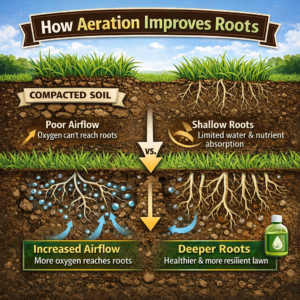
How Aeration Improves Roots by Reducing Soil Compaction
Soil compaction is one of the biggest threats to root health, as documented in university turfgrass research. Over time, foot traffic, mowing, rainfall, and natural settling press soil particles tightly together. As this pressure builds, roots lose the space they need to grow and expand.
This is where how aeration improves roots becomes clear. By loosening compacted soil, aeration restores physical space within the root zone. As a result, roots expand both outward and downward instead of remaining shallow near the surface. In turn, deeper roots anchor grass more effectively while improving access to water and nutrients.
Liquid aeration performs especially well in these conditions. Rather than pulling soil plugs, it penetrates compacted zones and relaxes soil bonds throughout the profile. Because of that, compaction relief occurs more evenly across the entire root zone, supporting consistent root development.
How Aeration Improves Roots Through Better Oxygen Flow
Roots need oxygen just as much as they need water. Unfortunately, compacted soil restricts air movement and limits root respiration. When oxygen levels drop, roots weaken and growth slows.
Understanding how aeration improves roots means recognizing the role of airflow. By reopening soil structure, aeration restores air pathways that allow oxygen to reach roots consistently. As a result, root systems produce energy more efficiently and support stronger top growth.
Liquid aeration improves oxygen flow without damaging the lawn surface. Because it increases porosity instead of leaving open holes, airflow remains steady and uniform across the lawn. Therefore, roots benefit continuously rather than temporarily.
How Aeration Improves Roots by Increasing Nutrient Uptake
Even the best fertilizer cannot work if roots cannot access nutrients. However, compacted soil blocks nutrient movement and limits absorption.
This is another reason how aeration improves roots matters. By opening soil structure, aeration allows nutrients to move freely into the root zone. Once nutrients arrive, roots absorb them more efficiently. As a result, growth becomes more balanced and predictable.
Liquid aeration enhances this process even further. Because it improves penetration throughout the soil profile, nutrients move deeper and stay available longer. Therefore, fertilizer applications work more effectively and support sustained root development.
How Aeration Improves Roots by Encouraging Deeper Root Growth
Shallow roots create fragile lawns. For example, grass with limited root depth dries out faster and struggles during heat stress. In addition, shallow roots increase damage from foot traffic.
That is why how aeration improves roots directly impacts lawn durability. By reducing compaction and restoring airflow, aeration encourages roots to grow deeper where moisture levels remain more stable. As a result, grass recovers faster from stress and resists environmental pressure.
Liquid aeration supports this without surface disruption. Because the lawn remains intact, roots respond quickly and continue developing without interruption. In contrast, mechanical aeration often slows recovery.
How Aeration Improves Roots More Effectively With Liquid Aeration
Not all aeration methods deliver the same results. While core aeration removes soil plugs, it often creates uneven coverage and surface disruption. In addition, open holes can dry out quickly.
When comparing methods, how aeration improves roots becomes more consistent with liquid aeration. Rather than tearing soil apart, liquid treatments work through the soil profile to relax compaction chemically. As a result, improvement occurs evenly and safely.
Furthermore, liquid aeration works during more parts of the growing season. Because it does not damage turf, it supports continuous root development without recovery delays.
How Aeration Improves Roots Over the Long Term
Root health is not a one-time fix. Instead, it requires steady improvement to soil conditions over time through professional aeration services.
This is the final reason how aeration improves roots remains so important. With consistent aeration, roots strengthen season after season. Over time, lawns show better color, thicker growth, and improved resistance to drought, heat, and wear.
At Dr. Green Services, liquid aeration supports long-term lawn science. Because it improves soil gradually and safely, it allows roots to perform at their best year after year. For deeper insights, explore our lawn care resources to learn how science-driven care keeps lawns healthy.
Hear What Our Happy Customers Have to Say!
For a Limited Time
Get Started Today and Enjoy Our Special Offer: Free Grub Control, Free Aeration, Free Fungicide, and Free Turf-Damaging Insect Control! Plus, Save 10% When You Prepay!
Your Local Lawn Care Experts
Dallas-Fort Worth
Address
3333 Earhart Dr., Suite 200
Carrollton, TX 75006
Phone Number
1-800-465-2934
Ready to elevate your lawn care game?
Get a free quote today.