
Oxygen Flow Roots: Why Lawn Roots Need Air to Stay Healthy
Oxygen flow roots depend on steady airflow through the soil to survive and grow. While water and nutrients often get the most attention, oxygen plays an equally critical role in root health. In fact, without enough air in the soil, roots weaken, growth slows, and lawns struggle to recover from stress. Because of this, understanding how oxygen moves through soil explains why lawn aeration science plays such a vital role in long-term lawn health.
Moreover, oxygen availability directly affects how roots absorb nutrients and manage energy. When airflow improves, lawns respond with stronger growth, better color, and greater resilience—an outcome closely tied to lawn care science and how grass functions below the surface.
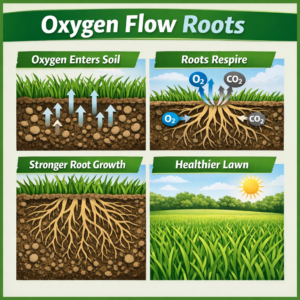
Why Oxygen Flow Roots Matter for Root Health
Grass roots constantly respire, meaning they take in oxygen and release carbon dioxide throughout the day. This process fuels root growth, nutrient absorption, and energy production. Therefore, when oxygen flow drops, roots lose efficiency almost immediately.
As a result, lawns may appear thin, pale, or slow to respond to fertilizer applications. Over time, poor airflow conditions reduce root depth and density. Consequently, grass becomes more vulnerable to heat stress, drought conditions, and heavy foot traffic.
How Oxygen Flow Roots Receive Air Through Soil
Healthy soil contains countless tiny air pockets between soil particles. These spaces allow oxygen to move downward into the root zone while carbon dioxide escapes upward. As long as this exchange remains balanced, roots receive the air they need to function properly. According to guidance from the University of Illinois Extension, healthy lawn soil must allow oxygen to move freely into the root zone in order to support proper root respiration and long-term turf health.
However, soil structure does not remain perfect on its own. When soil becomes compacted or overly saturated, airflow declines quickly. Then, oxygen availability drops, even though water and nutrients may still be present. Because roots cannot access oxygen efficiently, overall lawn performance begins to decline. This is why understanding liquid aeration vs core aeration matters, because not all aeration methods restore oxygen flow into compacted soil the same way.
What Blocks Oxygen Flow to Roots
Several common lawn conditions interfere with the airflow roots rely on for survival. Often, these issues develop slowly, which makes them easy to overlook at first. One of the most common issues is soil compaction, which closes the air spaces roots depend on.
• Soil compaction closes the air spaces roots depend on
• Excess moisture pushes oxygen out of the soil profile
• Heavy foot traffic repeatedly compresses the root zone
• Thick thatch buildup restricts gas exchange at the surface
Because these problems build gradually, lawns often experience oxygen stress long before visible damage appears above ground.
How Poor Oxygen Flow Reduces Lawn Performance
When roots lack oxygen, lawns respond in predictable ways. First, growth slows and recovery times increase. Then, roots remain shallow, which limits water and nutrient uptake—an issue closely tied to grass root growth science and how roots develop below the surface.
Eventually, reduced oxygen availability contributes to thinning turf, higher disease pressure, and reduced tolerance to environmental stress. At that point, surface treatments alone cannot correct the underlying issue, because the problem exists beneath the soil surface.
How Aeration Restores Oxygen Flow Roots Need
Aeration improves oxygen flow by reopening soil structure and restoring air pathways into the root zone. By loosening compacted soil and increasing porosity, aeration allows oxygen to reach roots more consistently.
At Dr. Green Services, aeration decisions follow soil conditions and seasonal root activity rather than fixed calendar dates. Therefore, this science-driven approach—rooted in preventative lawn care science—improves oxygen flow at the most effective times. As a result, lawns develop stronger roots, better nutrient efficiency, and improved long-term health.
Oxygen Flow Roots Form the Foundation of a Healthy Lawn
Strong lawns always start below the surface. Oxygen flow roots support everything from root growth to nutrient efficiency and stress tolerance. When airflow improves, roots grow deeper, grass becomes more resilient, and lawns recover faster from seasonal challenges.
By focusing on soil health instead of surface appearance alone, professional aeration services help lawns thrive season after season. For homeowners who want to better understand the science behind healthy turf, our lawn care resources provide clear, research-backed guidance to support smarter lawn care decisions.
Hear What Our Happy Customers Have to Say!
For a Limited Time
Get Started Today and Enjoy Our Special Offer: Free Grub Control, Free Aeration, Free Fungicide, and Free Turf-Damaging Insect Control! Plus, Save 10% When You Prepay!
Your Local Lawn Care Experts
Dallas-Fort Worth
Address
3333 Earhart Dr., Suite 200
Carrollton, TX 75006
Phone Number
1-800-465-2934
Ready to elevate your lawn care game?
Get a free quote today.