
Liquid Aeration vs Core Aeration: Understanding the Difference
Liquid aeration vs core aeration is often framed as a simple choice. However, when you look at lawn care science, the difference becomes much clearer. Both methods aim to relieve compaction and improve oxygen flow. Yet, they achieve those goals in very different ways.
Core aeration relies on mechanical force to remove soil plugs. In contrast, liquid aeration uses soil-conditioning solutions that penetrate the soil profile, a process rooted in lawn aeration science. As a result, liquid aeration restructures compacted soil from within instead of tearing it apart at the surface.
Because of this fundamental difference, liquid aeration delivers more consistent and longer-lasting improvements to soil health.
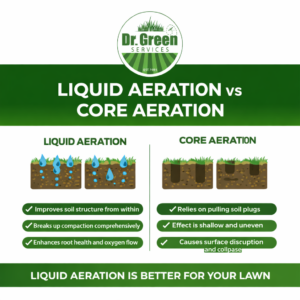
How Liquid Aeration vs Core Aeration Affects Soil Structure
Soil compaction limits oxygen, water, and nutrient movement. Therefore, any effective aeration method must restore pore space throughout the root zone.
With core aeration, machines punch holes and remove plugs. At first, this opens the surface. However, surrounding soil often collapses back into place. Over time, compaction remains below the plug depth.
Liquid aeration works differently. Instead of removing soil, it breaks the bonds between compacted particles. Consequently, soil aggregates separate and pore space increases throughout the profile. Because of this, airflow and water movement improve more evenly.
Ultimately, liquid aeration corrects soil structure rather than temporarily disturbing it.
Why Liquid Aeration vs Core Aeration Impacts Oxygen Flow Differently
Oxygen fuels root growth and microbial activity. Without it, roots weaken and nutrient uptake slows.
Core aeration improves oxygen flow only near each hole. However, that airflow depends on hole spacing, depth, and whether soil collapses afterward. As a result, benefits often fade quickly in compacted lawns.
Liquid aeration improves oxygen flow across the entire treated area. Instead of relying on open holes, it restores natural air pathways within the soil. Because of this, roots receive consistent oxygen access rather than isolated bursts.
Therefore, liquid aeration supports healthier root systems over time.
Liquid Aeration vs Core Aeration and Root Development
Roots grow where soil allows them to grow. Unfortunately, compacted soil forces roots to remain shallow.
With core aeration, roots may expand near plug openings. However, they often avoid surrounding compacted zones. As a result, root growth becomes uneven.
Liquid aeration conditions the soil so roots can expand naturally in all directions. Consequently, root systems grow deeper and denser. In addition, improved soil structure allows roots to access water more efficiently during dry periods.
Stronger roots directly translate into stronger turf.
The Long-Term Results of Liquid Aeration vs Core Aeration
Short-term disruption does not equal long-term improvement. That distinction matters.
Core aeration often requires repeated mechanical treatments. Over time, repeated passes can increase surface disruption and contribute to uneven soil layers. Furthermore, results depend heavily on timing and weather.
Liquid aeration improves soil gradually and cumulatively. Each application builds on the last, improving aggregation and porosity. Because the soil structure actually changes, compaction becomes easier to manage long term.
For this reason, liquid aeration aligns far better with science-based lawn care.
The Downsides of Core Aeration
Core aeration introduces several limitations that affect results and consistency. For example:
-
Surface disruption and visible plugs
-
Limited depth based on machine capability
-
Inconsistent coverage in heavily compacted soil
-
Soil collapse after treatment
-
Seasonal and scheduling restrictions
Additionally, mechanical aeration can damage irrigation components and shallow roots. Because of that, it introduces risks that liquid aeration avoids entirely.
Rather than fixing the cause of compaction, core aeration often treats symptoms.
Why Liquid Aeration Is Better for Lawn Health
Liquid aeration improves soil biology, oxygen flow, and root access without tearing up the lawn surface. More importantly, it works with soil physics rather than against it, which aligns with university research on maintaining healthy lawns.
Because liquid aeration does not rely on physical removal, it prevents compaction rebound. Instead, it restores balance within the soil profile. As a result, lawns respond faster and maintain improvements longer.
This is precisely why liquid aeration is better for overall lawn health.
Science-Driven Aeration at Dr. Green Services
At Dr. Green Services, aeration decisions follow soil conditions and root activity, not outdated mechanical habits. Therefore, liquid aeration fits a science-first approach and is delivered through our professional aeration service.
By improving soil structure from within, liquid aeration supports stronger roots, better oxygen flow, and more efficient nutrient use. When combined with long-term strategies found in our lawn care resources, it delivers lasting improvements instead of temporary disruption.
Hear What Our Happy Customers Have to Say!
For a Limited Time
Get Started Today and Enjoy Our Special Offer: Free Grub Control, Free Aeration, Free Fungicide, and Free Turf-Damaging Insect Control! Plus, Save 10% When You Prepay!
Your Local Lawn Care Experts
Dallas-Fort Worth
Address
3333 Earhart Dr., Suite 200
Carrollton, TX 75006
Phone Number
1-800-465-2934
Ready to elevate your lawn care game?
Get a free quote today.