
Why Insect Damage Appears in Lawn Patches
Insect damage patches are one of the most common and misunderstood patterns in residential lawns. Instead of spreading evenly, insect-related turf injury develops in scattered areas that slowly expand. Homeowners often confuse these patterns with drought or disease, but lawn care science explains that insect behavior and turf biology below the surface drive this type of damage.
When turf-damaging insects feed and move through soil, they create predictable stress patterns that explain why lawns decline unevenly — a core principle within turf-damaging insect science.
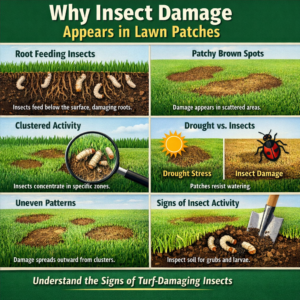
How Insect Damage Patches Begin Below the Soil Surface
Most turf-damaging insects spend much of their life cycle underground. They feed at the roots or crown, where grass absorbs water and nutrients. University extension research shows that many turf-damaging insects feed below the surface, which explains why damage often develops in localized patches rather than spreading evenly across the lawn.
As roots weaken in specific areas, grass loses its ability to tolerate stress. Above-ground symptoms appear only after this underground injury progresses, which explains the sudden visibility of patch-style damage.
Why Insect Damage Creates Uneven Lawn Patterns
Insects do not move evenly through turf. Soil temperature, moisture, oxygen levels, and root density guide their movement. When grass declines in one area, nearby plants lose resilience and become easier targets.
Feeding pressure then spreads outward. This expansion creates irregular shapes instead of straight lines, which helps distinguish insect-related injury from mowing or irrigation issues.
Patchy Lawn Damage vs Drought Stress
Homeowners often mistake patch-based turf damage for drought stress because both cause browning and thinning. Chinch bug lawn damage, however, often develops under hot, dry conditions and does not improve with additional watering.
Water response provides another clue. When irrigation improves surrounding turf but damaged areas continue to decline, insect activity below the surface usually drives the problem.
Root Feeding and Localized Insect Injury
Each grass plant relies on its own root system. When insects feed on roots, individual plants weaken and collapse before neighboring plants show stress. This selective failure creates visible gaps in turf density.
As soil becomes exposed, surface temperatures rise and moisture retention declines. These changes attract continued insect activity and intensify localized damage.
Why Insect Damage Appears in Clusters
Many turf insects hatch in concentrated areas or overwinter in protected soil pockets. The sod webworm life cycle explains why feeding damage often appears in clusters and becomes more visible as larvae mature.
These early clusters form the starting point of uneven lawn damage. As insects mature and continue feeding, damage expands outward while distant turf remains unaffected.
Environmental Stress and Patch-Style Insect Damage
Heat, soil compaction, and moisture imbalance weaken turf recovery. When grass experiences stress, even low insect pressure can overwhelm root systems.
This interaction explains why patch-style damage often becomes visible during summer stress, even when insects established earlier in the season.
Why Patchy Lawn Damage Signals Ongoing Insect Activity
Visible turf symptoms lag behind insect feeding. By the time discoloration appears, root injury has already progressed. Damage may continue to worsen even after weather conditions improve.
Patch-style decline usually reflects sustained biological pressure rather than a single short-term event.
What Patch Patterns Reveal About Turf Health
Localized damage patterns reveal how well turf tolerates stress. Dense root systems and balanced growth allow lawns to withstand limited insect feeding without visible injury.
Shallow roots and uneven growth reduce tolerance. In those cases, localized insect pressure quickly produces patchy lawn damage.
Insect Damage Patches and Turf-Damaging Insect Science
Turf-damaging insect science relies on pattern recognition. Damage that appears in clusters, spreads gradually, and resists watering points to root-level disruption rather than surface stress — a key focus of professional turf-damaging insect control programs.
When homeowners understand why insect damage patches form, lawn care resources help shift decisions away from reacting to symptoms and toward strengthening turf biology for long-term stability.
Hear What Our Happy Customers Have to Say!
For a Limited Time
Get Started Today and Enjoy Our Special Offer: Free Grub Control, Free Aeration, Free Fungicide, and Free Turf-Damaging Insect Control! Plus, Save 10% When You Prepay!
Your Local Lawn Care Experts
Dallas-Fort Worth
Address
3333 Earhart Dr., Suite 200
Carrollton, TX 75006
Phone Number
1-800-465-2934
Ready to elevate your lawn care game?
Get a free quote today.