
Sod Webworm Life Cycle
Sod webworms are common turf-damaging insects found in many residential lawns. Although damage often seems to appear suddenly, it actually follows a predictable biological pattern rooted in lawn care science. By understanding the sod webworm life cycle, lawn damage becomes easier to explain, anticipate, and manage.
Rather than occurring at random, sod webworm activity closely follows temperature, seasonal timing, and turf health. As a result, this page explains how each development stage affects grass and why damage often appears in localized patches—a concept explored more broadly within turf-damaging insect science.
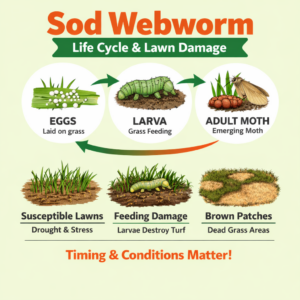
The Sod Webworm Life Cycle Explained
The sod webworm life cycle includes four stages: egg, larva, pupa, and adult moth, as outlined by University of Illinois Extension. Importantly, meaningful turf damage occurs during only one of these stages.
Because each phase responds differently to environmental conditions, timing plays a critical role. Therefore, understanding these development stages helps explain why some lawns show injury while others remain unaffected.
Eggs are laid on grass blades during warm evenings. Shortly after, larvae hatch and begin feeding near the soil surface. Once feeding is complete, larvae transition into pupae below the turf before emerging as adult moths. Although adult moths do not damage grass directly, they signal renewed reproductive activity and the potential for future infestations.
As a result, lawn damage often reflects insect activity that began weeks earlier. When turf health is already compromised by stress, the impact of each stage becomes more visible. Understanding this progression allows lawn care decisions to align with insect biology rather than reacting only after symptoms appear.
Egg Stage of the Sod Webworm Life Cycle
The egg stage begins when adult moths lay eggs on grass blades during warm evenings. Typically, this occurs when turf growth is steady and nighttime temperatures remain elevated.
Soon after, eggs hatch based on moisture and heat accumulation. At this point, turf appears normal. However, insect pressure has already begun to build. Consequently, early infestations are rarely detected without close inspection.
Larval Feeding and Turf Damage
Larvae are responsible for nearly all visible sod webworm injury. After hatching, they migrate toward the soil surface and begin feeding on grass blades, crowns, and tender tissue.
Because feeding takes place primarily at night, damage develops gradually. Over time, grass thins, loses density, and shows uneven discoloration. Additionally, larvae often remain close to where they hatch, which explains why injury appears in irregular patches rather than across the entire lawn.
Pupal Stage in the Sod Webworm Life Cycle
After completing feeding, larvae transition into pupae just below the soil surface. During this phase of the sod webworm life cycle, active feeding stops.
However, development continues internally. Depending on temperature patterns, pupation may last several days or longer. As a result, seasonal conditions strongly influence how quickly adult insects reappear and restart the cycle.
Adult Moths and Repeating Life Cycles
Adult moths represent the final developmental stage. Although they do not feed on turf, they play a critical role in population renewal.
Often observed flying low over lawns at dusk, adult moths signal favorable egg-laying conditions. Therefore, repeated moth activity usually indicates that multiple generations are developing within the same growing season.
Why Sod Webworm Damage Appears in Patches
Patchy turf injury is one of the most recognizable signs of sod webworm activity. This pattern develops because egg deposition is localized rather than evenly distributed.
As larvae feed, grass weakens in specific areas first. Meanwhile, surrounding turf may remain relatively healthy. Consequently, lawns exhibit irregular thinning instead of uniform stress symptoms.
Turf Stress and the Sod Webworm Life Cycle
Turf condition strongly influences how the sod webworm life cycle impacts lawn appearance. In particular, stressed turf shows more pronounced injury, especially when insect root damage limits the plant’s ability to absorb water and nutrients.
For example, drought stress, compaction, shallow roots, and nutrient imbalance reduce turf recovery. When grass struggles to regrow between feeding events, damage becomes more persistent. In contrast, dense turf with steady growth tolerates surface feeding more effectively.
Environmental Conditions That Influence Activity
Weather patterns directly affect insect development and feeding intensity. Warm temperatures accelerate growth, while extended moisture can improve larval survival—a pattern also observed with chinch bugs, which thrive under similar environmental stress conditions.
Additionally, turf under heat or drought stress recovers more slowly. Therefore, the same level of insect pressure may cause minimal injury in one lawn but severe damage in another. This variability explains why sod webworm injury is inconsistent from property to property.
Using the Sod Webworm Life Cycle for Better Lawn Care Decisions
Ultimately, understanding the sod webworm life cycle shifts lawn care from reaction to prevention. Instead of responding only after turf browns, science-based strategies—such as turf-damaging insect control—focus on timing, turf strength, and stress reduction.
As turf health improves, resilience increases. Consequently, lawns recover faster and experience fewer recurring problems throughout the season, especially when care decisions align with proven lawn care resources and biological principles.
At Dr. Green Services, turf-damaging insect management follows this biological approach. By aligning care decisions with insect development patterns and turf condition, lawns remain healthier and more consistent year after year.
Hear What Our Happy Customers Have to Say!
For a Limited Time
Get Started Today and Enjoy Our Special Offer: Free Grub Control, Free Aeration, Free Fungicide, and Free Turf-Damaging Insect Control! Plus, Save 10% When You Prepay!
Your Local Lawn Care Experts
Dallas-Fort Worth
Address
3333 Earhart Dr., Suite 200
Carrollton, TX 75006
Phone Number
1-800-465-2934
Ready to elevate your lawn care game?
Get a free quote today.