
Untreated Grub Damage in Lawns
Untreated grub damage occurs when white grubs feed below the soil surface without interruption, a process well explained by modern lawn care science that focuses on root health rather than surface appearance. While lawns may look healthy at first, damage develops quietly where it cannot be seen. Over time, continuous root feeding weakens turf structure, limits recovery, and leads to long-term lawn decline that becomes harder to correct.
Because this process happens underground, homeowners often do not realize a problem exists until visible symptoms appear. By then, significant root loss may already be present, underscoring why grub control science emphasizes early intervention before turf stability collapses.
What Untreated Grub Damage Means for Your Lawn
Grubs feed on grass roots, not grass blades. When infestations go untreated, this feeding continues through critical growth periods. As roots thin and break, turf loses its ability to anchor itself, absorb moisture, and take in essential nutrients, a process well documented by Penn State Extension’s research on white grubs.
Without healthy roots, grass cannot support consistent growth. As a result, lawns lose density and stability even when surface conditions appear normal. This hidden damage explains why lawns sometimes fail suddenly rather than declining slowly.
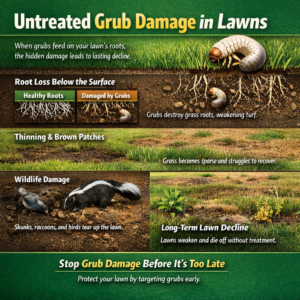
Untreated Grub Damage and Progressive Root Loss
Grub damage intensifies as larvae mature. Early feeding creates small breaks in the root system, but larger grubs consume roots at a much faster rate. As feeding pressure increases, root density drops rapidly.
This loss weakens the connection between grass and soil. Turf becomes easier to pull up, struggles to fill in thin areas, and responds poorly to watering and fertilization. Over time, weakened roots limit the lawn’s ability to recover from normal seasonal stress.
How Untreated Grub Damage Leads to Thinning Turf
As grub damage continues, lawns lose their ability to repair themselves. Normal stress from mowing, foot traffic, or temperature changes becomes more damaging. Instead of rebounding, grass growth slows and thinning spreads.
Bare or sparse areas often expand during warm weather. At this stage, surface treatments alone cannot restore density because the root foundation is no longer intact. Without stopping grub activity, recovery remains limited.
Untreated Grub Damage Increases Heat and Drought Stress
Healthy roots allow grass to manage moisture efficiently. Grub damage reduces root depth and overall root mass, limiting the lawn’s ability to draw water from the soil. As a result, turf shows drought stress much sooner.
Even frequent watering may fail to improve conditions. Without sufficient roots, grass cannot retain moisture or regulate temperature effectively. This makes lawns far more vulnerable during extended heat or dry periods.
Secondary Lawn Damage Caused by Grubs and Wildlife
If grubs are left untreated, wildlife often becomes involved. Skunks, raccoons, and birds dig into lawns searching for grubs, causing surface disruption and torn turf. While this damage appears sudden, it typically follows prolonged underground feeding.
Wildlife activity often signals advanced root loss. At this point, lawns suffer from both below-ground damage and visible surface destruction.
Long-Term Lawn Decline from Untreated Grub Damage
Untreated grub damage does not correct itself over time. Each feeding season further weakens turf density and resilience. As lawns thin, weeds establish more easily, and grass becomes less tolerant of environmental stress.
Recovery slows with each passing year. In many cases, lawns never fully regain strength without professional intervention that stops feeding and protects remaining roots.
Why Preventing Grub Damage Matters
Preventing grub damage means interrupting grub development before feeding escalates. When root systems remain intact, grass can support steady growth, recover from stress, and maintain density throughout the season.
This proactive approach protects the lawn’s foundation instead of reacting after decline appears.
Science-Based Solutions Stop Untreated Grub Damage
Unchecked feeding creates long-term setbacks that surface treatments cannot fix. However, professional grub control targets the problem at the biological level, preventing untreated grub damage before root systems collapse and allowing lawns to maintain stability through the season.
By protecting roots early, this science-driven approach supports stronger lawns year after year. When combined with proven lawn care resources, it helps prevent the cycle of recurring decline instead of reacting after visible damage appears.
Hear What Our Happy Customers Have to Say!
For a Limited Time
Get Started Today and Enjoy Our Special Offer: Free Grub Control, Free Aeration, Free Fungicide, and Free Turf-Damaging Insect Control! Plus, Save 10% When You Prepay!
Your Local Lawn Care Experts
Dallas-Fort Worth
Address
3333 Earhart Dr., Suite 200
Carrollton, TX 75006
Phone Number
1-800-465-2934
Ready to elevate your lawn care game?
Get a free quote today.