
Chinch Bug Lawn Damage Science
Chinch bug damage is one of the most common yet misunderstood causes of summer lawn decline. Because symptoms often resemble drought stress or disease, lawns affected by chinch bugs are frequently misdiagnosed. However, turf injury caused by chinch bug feeding follows a specific biological process that disrupts plant function from the inside out — a pattern frequently explained within lawn care science.
To understand how chinch bugs weaken turf, it is necessary to look beyond surface symptoms and examine how insect feeding alters grass physiology during periods of environmental stress, a core concept within turf-damaging insect science.
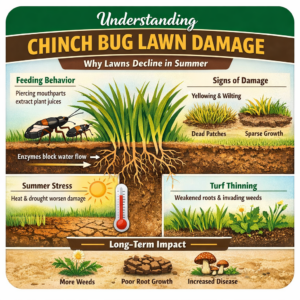
How Chinch Bug Damage Develops in Turfgrass
Damage begins at the crown of the grass plant near the soil surface. Rather than chewing leaf tissue, chinch bugs use piercing-sucking mouthparts to extract fluids from stems and crowns. During feeding, they also inject enzymes that interfere with normal plant function, a process well documented in university-based chinch bug management research.
This feeding behavior disrupts the movement of water and nutrients within the plant’s vascular system. As internal transport breaks down, grass loses its ability to maintain hydration and cellular stability, even when soil moisture is adequate.
Why Chinch Bug Lawn Damage Accelerates During Summer
Chinch bug lawn damage becomes most severe during hot, dry weather because turfgrass is already under physiological stress. High temperatures slow growth, reduce recovery capacity, and increase water demand within plant tissues.
At the same time, chinch bug populations expand rapidly in warm conditions. As insect activity increases and turf resilience declines, feeding injury accumulates faster than grass can repair itself.
Physiological Effects of Chinch Bug Feeding
Unlike surface-level stress, chinch bug feeding causes internal failure within the grass plant. As water transport becomes restricted, cells lose turgor pressure, which leads to wilting, yellowing, and eventual tissue death.
Because the problem occurs inside the plant, additional irrigation does not restore function. Grass may continue to decline despite adequate watering, which is a key indicator that insect activity — not drought alone — is driving the damage.
Distinguishing Chinch Bug Injury from Drought Stress
Chinch bug injury is commonly mistaken for drought stress because both produce similar visual symptoms. However, the underlying mechanisms differ significantly—a pattern also reflected in the sod webworm life cycle, where feeding activity disrupts turf function before surface damage becomes obvious.
Drought stress results from limited water availability in the soil. In contrast, insect feeding prevents grass from moving water internally. This distinction explains why lawns fail to respond to watering when chinch bugs are present.
Turfgrass Response to Chinch Bug Damage
As feeding pressure increases, turfgrass shifts resources away from growth and toward survival. Root development slows, leaf production declines, and turf density decreases. Over time, thinning turf exposes soil to direct sunlight, which raises surface temperatures and compounds stress.
This weakened condition reduces the lawn’s ability to tolerate insects, heat, and moisture fluctuations, allowing affected areas to expand. This weakened condition reduces the lawn’s ability to tolerate insects, heat, and moisture fluctuations, allowing affected areas to expand. As root systems decline under continued stress, turf becomes more vulnerable to insect root damage, which further accelerates lawn deterioration.
How Chinch Bug Lawn Damage Spreads Across Lawns
Chinch bug lawn damage spreads in predictable patterns tied to temperature and microclimate. Insects concentrate in warm, dry areas such as south-facing slopes, compacted zones, and locations near sidewalks or driveways.
As grass deteriorates in these high-stress areas, chinch bugs migrate outward to healthier turf, creating expanding patches of decline.
Long-Term Impact of Chinch Bug Damage
When left unmanaged, feeding injury leads to chronic thinning and weakened root systems. Lawns become more vulnerable to weed invasion, soil compaction, and disease pressure.
Repeated seasons of stress reduce turf resilience and make recovery slower each year.
Managing Chinch Bug Damage Through Turf Biology
Effective management focuses on turf biology rather than reacting to symptoms alone. Dense growth, strong roots, and balanced moisture improve tolerance to limited insect pressure, principles reinforced throughout our lawn care resources.
At Dr. Green Services, turf-damaging insect management follows this biological framework. By combining plant health strategies with targeted protection through our turf-damaging insect control service, environmental stress, plant health, and insect pressure are addressed together so lawns develop greater resistance and recover more reliably over time.
Hear What Our Happy Customers Have to Say!
For a Limited Time
Get Started Today and Enjoy Our Special Offer: Free Grub Control, Free Aeration, Free Fungicide, and Free Turf-Damaging Insect Control! Plus, Save 10% When You Prepay!
Your Local Lawn Care Experts
Dallas-Fort Worth
Address
3333 Earhart Dr., Suite 200
Carrollton, TX 75006
Phone Number
1-800-465-2934
Ready to elevate your lawn care game?
Get a free quote today.