
How Mosquito Barrier Treatments Work
Mosquito barrier treatments are a science-based method for reducing mosquito activity by targeting where mosquitoes rest, travel, and survive. Rather than focusing only on biting events, this approach addresses the biological patterns that allow mosquito populations to persist near homes. As a result, control efforts shift from reaction to prevention, which aligns closely with the principles outlined in mosquito control science.
To fully understand how this method works, it is necessary to look at mosquito behavior, environmental conditions, and survival requirements together rather than in isolation. These factors are also influenced by broader lawn care science, including moisture management, plant density, and property conditions that affect pest activity.
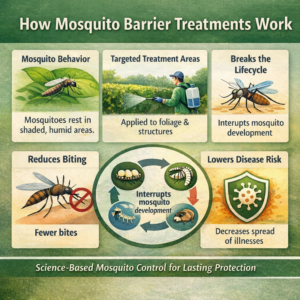
The Science Behind Mosquito Behavior
Adult mosquitoes do not spend most of their time flying. Instead, after feeding or breeding, they seek protected areas that allow them to conserve moisture and regulate body temperature. Because mosquitoes are highly sensitive to heat and dehydration, shaded and humid locations become essential for survival.
Therefore, resting behavior is not random. Over time, mosquitoes repeatedly return to the same protected zones. This consistency creates predictable patterns that can be studied, mapped, and disrupted using biology-based control methods, as outlined in the CDC’s guidance on integrated mosquito management.
How Mosquito Barrier Treatments Target Resting Areas
Rather than attempting to control mosquitoes in open air, this approach focuses on surfaces where mosquitoes naturally land, a core principle of professional mosquito control. Foliage, shaded structural edges, and sheltered transition areas all serve as frequent contact points.
When these surfaces are treated, mosquitoes encounter conditions that interfere with their normal movement and recovery cycles. As a result, their ability to remain active in the area decreases. Over time, repeated exposure reduces survival and limits how long mosquitoes can persist near living spaces.
Why Mosquito Barrier Treatments Reduce Mosquito Activity
Mosquitoes depend on resting periods to recover between feeding and breeding cycles. Without safe resting zones, their energy reserves decline more quickly. Consequently, fewer mosquitoes survive long enough to reproduce or bite repeatedly.
Because this method disrupts behavior rather than chasing symptoms, mosquito pressure gradually declines. In contrast to short-term solutions, population reduction becomes more consistent and predictable as biological stress increases across multiple stages of the mosquito life cycle.
How Mosquito Barrier Treatments Fit Into Mosquito Control Science
Within mosquito control science, effective management focuses on limiting survival and movement rather than attempting complete elimination. Since mosquitoes are highly adaptable, long-term reduction depends on disrupting multiple stages of their lifecycle.
For this reason, barrier-based approaches are most effective when paired with habitat awareness and preventative timing. Together, these strategies reduce population pressure while supporting sustainable control outcomes.
Environmental Factors That Influence Mosquito Barrier Treatments
Environmental conditions play a significant role in how treatments perform over time. Rainfall, irrigation patterns, and seasonal growth all affect mosquito activity and resting behavior.
Additionally, plant density and shade levels influence where mosquitoes concentrate. As these conditions change, treatment strategies must adapt. Therefore, understanding environmental influence is critical for maintaining consistent results.
Why Mosquito Barrier Treatments Are Preventative
Preventative timing plays a key role in long-term success. When control measures begin early—such as through perimeter pest treatments that intercept pests before populations expand—fewer mosquitoes survive to establish stable populations. As a result, reproduction slows before peak activity periods arrive.
From a biological perspective, early disruption creates cumulative stress. Over time, this stress limits population growth and reduces the need for reactive intervention later in the season.
The Importance of Coverage Consistency
Consistent surface coverage is essential because mosquitoes will exploit untreated areas whenever possible. Even small gaps provide opportunities for recovery and shelter.
Therefore, science-based applications focus on continuity rather than spot treatment. When coverage remains consistent, mosquitoes encounter repeated exposure, which strengthens overall effectiveness.
Long-Term Impact of Mosquito Barrier Treatments
Although no method eliminates mosquitoes entirely, sustained pressure reduces their ability to thrive in a given area. Over time, fewer mosquitoes survive long enough to bite, reproduce, and spread. As mosquito pressure declines, the likelihood of repeated human exposure decreases, which directly influences patterns of mosquito-borne disease transmission.
As a result, outdoor environments become more usable and predictable. Importantly, this outcome reflects population management rather than temporary relief.
Connecting Mosquito Control to Property Conditions
Mosquito activity is closely tied to moisture, shade, and vegetation. Because of this, control strategies naturally overlap with broader property management decisions and professional mosquito control service planning.
When mosquito management is guided by biology and environmental awareness, results remain more stable. Ultimately, this science-driven approach supports healthier, more comfortable outdoor spaces over the long term, especially when paired with reliable lawn care resources that address moisture and plant growth.
Hear What Our Happy Customers Have to Say!
For a Limited Time
Get Started Today and Enjoy Our Special Offer: Free Grub Control, Free Aeration, Free Fungicide, and Free Turf-Damaging Insect Control! Plus, Save 10% When You Prepay!
Your Local Lawn Care Experts
Dallas-Fort Worth
Address
3333 Earhart Dr., Suite 200
Carrollton, TX 75006
Phone Number
1-800-465-2934
Ready to elevate your lawn care game?
Get a free quote today.