
Broadleaf Weeds vs Grassy Weeds
Understanding broadleaf vs grassy weeds is a fundamental principle of weed control science. Although these weed types often appear together in lawns, they differ significantly in structure, growth behavior, and response to treatment. Because of these differences, effective weed control begins with identifying weed type rather than reacting to visible symptoms alone — a concept rooted in lawn care science.
When weed classification is overlooked, treatments often deliver short-lived results. As a result, lawns remain vulnerable to repeat infestations and ongoing competition.
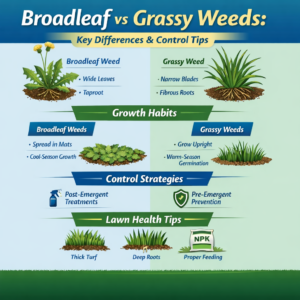
Broadleaf Weeds vs Grassy Weeds: Core Biological Differences
At a biological level, broadleaf vs grassy weeds differ in how they grow, spread, and compete with turfgrass. As outlined in university research on lawn weed management, these structural differences influence how weeds establish and how they should be controlled.
Broadleaf weeds develop wider leaves and distinct vein patterns that separate them from lawn grass. In contrast, grassy weeds closely resemble turfgrass and share similar blade shape and growth form.
Because these differences exist at the structural level, each weed category responds to different control strategies. Therefore, accurate identification becomes the foundation of successful weed management.
Broadleaf Weeds vs Grassy Weeds and Plant Structure
Plant structure plays a central role in distinguishing broadleaf vs grassy weeds and selecting appropriate treatments. For example, dandelions display classic broadleaf characteristics that make them identifiable and responsive to selective control methods.
Broadleaf weeds typically show:
-
Wide or rounded leaves
-
Net-like vein patterns
-
Taproots or branching root systems
Grassy weeds usually feature:
-
Narrow, upright blades
-
Parallel veins
-
Fibrous root systems similar to turfgrass
As a result, selective herbicides can target one group without affecting the other. However, when plant structure is misidentified, control efforts often fail.
Growth Habits and Weed Competition
Beyond structure, growth behavior further separates weed types and influences how quickly infestations develop.
Broadleaf weeds often grow outward, forming mats or rosettes that crowd turf at the soil surface. Consequently, they reduce light penetration and airflow. Grassy weeds, however, grow vertically and blend into existing turf, which makes early detection more difficult. A common example is crabgrass, which often establishes within thinning turf before it becomes visually obvious.
Because grassy weeds visually mimic lawn grass, they often establish unnoticed. Over time, this delayed recognition allows populations to expand and compete aggressively with turf.
Why Broadleaf Weeds vs Grassy Weeds Require Different Strategies
Weed control science does not rely on a single solution. Instead, treatment decisions change based on weed biology and growth pattern, including how weeds germinate and spread.
Broadleaf weeds frequently respond well to selective post-emergent applications during active growth. Grassy weeds, on the other hand, often require pre-emergent prevention or very precise post-emergent timing.
Therefore, identifying weed category first prevents wasted applications and unnecessary turf stress. When strategy follows biology, results become more predictable.
Broadleaf Weeds vs Grassy Weeds and Seasonal Timing
Seasonal growth patterns further separate broadleaf vs grassy weeds and explain why timing matters so much. This timing directly influences decisions around pre-emergent vs post-emergent weed control.
Many broadleaf weeds thrive during cooler conditions or rebound aggressively in fall. Meanwhile, grassy weeds typically germinate once soil temperatures reach specific thresholds in spring or early summer.
Because these patterns repeat each year, professional weed control aligns treatments with predictable biological windows. As a result, weed pressure is reduced before visible damage appears.
Root Systems and Underground Competition
While leaf structure often gets the most attention, root systems play an equally important role in weed persistence and competition with grass roots.
Some weeds develop deep or aggressive root structures that allow rapid recovery after surface damage. Others spread through fibrous roots that quickly occupy open soil. Consequently, surface removal alone rarely solves the problem.
This underground competition explains why weed control strategies must disrupt growth at multiple levels, not just what is visible above the soil.
Turf Density and Natural Weed Suppression
Although targeted treatments are important, turf health remains a powerful long-term defense.
Dense grass naturally shades the soil surface and limits the light weed seeds need to germinate. Additionally, strong root systems absorb water and nutrients more efficiently, especially when supported by slow release fertilizer programs that feed turf gradually instead of forcing growth. Therefore, fewer resources remain available for unwanted plants.
When lawn care supports steady turf growth, weed establishment becomes far less likely across all weed categories.
Environmental Stress and Weed Advantage
Environmental stress often shifts the balance in favor of weeds.
Heat, drought, soil compaction, and poor fertility weaken turfgrass. Meanwhile, many weeds tolerate these conditions more easily. As a result, stressed lawns provide open space for weeds to invade.
Because of this, weed control science always overlaps with broader lawn care practices. Improving growing conditions reduces weed pressure naturally over time.
Why Broadleaf Weeds vs Grassy Weeds Explain Long-Term Results
Understanding broadleaf vs grassy weeds helps explain why some lawns improve each season while others struggle year after year.
When weed control decisions follow plant biology, turf gains a competitive advantage. Over time, lawns grow thicker, recover faster, and resist new infestations more effectively when supported by consistent lawn care resources rooted in science.
At Dr. Green Services, weed control strategies integrate weed identification, seasonal timing, and turf response through a professional weed control service. As a result, homeowners see lasting improvement instead of short-term fixes.
Hear What Our Happy Customers Have to Say!
For a Limited Time
Get Started Today and Enjoy Our Special Offer: Free Grub Control, Free Aeration, Free Fungicide, and Free Turf-Damaging Insect Control! Plus, Save 10% When You Prepay!
Your Local Lawn Care Experts
Dallas-Fort Worth
Address
3333 Earhart Dr., Suite 200
Carrollton, TX 75006
Phone Number
1-800-465-2934
Ready to elevate your lawn care game?
Get a free quote today.