
Slow-Release vs Quick-Release Fertilizer
Slow-release vs quick-release fertilizer explains how different fertilizers deliver nutrients to grass and why release speed directly affects lawn health. While both types provide essential nutrients, they behave very differently once applied to soil. Understanding this difference helps explain why some lawns thrive while others struggle despite regular fertilization.
Although fertilizers may look similar on the surface, the science behind how nutrients move through soil tells a very different story. Once applied, fertilizer does not simply “feed” grass instantly. Instead, nutrients must dissolve, travel through soil, interact with microbes, and reach roots at the right time and concentration.
At Dr. Green Services, fertilizer decisions follow lawn fertilizer science—not shortcuts. Instead of chasing fast color, professional programs focus on how nutrients move through soil, how roots absorb them, and how grass responds over time.
What Slow-Release vs Quick-Release Fertilizer Means for Lawn Health
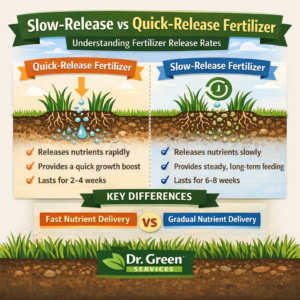
Fertilizer release rate describes how quickly nutrients become available to grass roots after application. Once fertilizer reaches the soil, water, temperature, and microbial activity determine how fast nutrients dissolve and move toward the root zone. Nutrient availability in turfgrass depends on how fertilizer interacts with soil moisture, microbes, and root systems—processes well documented in university turfgrass fertility research.
Grass roots do not absorb nutrients all at once. Instead, uptake happens gradually as roots grow, respire, and exchange nutrients with the surrounding soil. Because of this, nutrient availability must match the lawn’s biological pace, a core principle of lawn care science.
When fertilizer releases nutrients faster than roots can absorb them, efficiency drops. As a result, excess nutrients may leach below the root zone, wash away during rainfall, or volatilize into the air. Over time, this disrupts nutrient cycling and reduces overall lawn resilience, which lawn fertilizer science consistently warns against.
This is why slow-release vs quick-release fertilizer plays such a critical role in long-term turf health rather than just short-term appearance.
How Quick-Release Fertilizer Works
Quick-release fertilizer delivers nutrients rapidly after application. Most formulations dissolve quickly when watered, making nitrogen immediately available to grass blades.
Because nitrogen drives leaf growth, lawns often respond with fast green-up. For homeowners seeking instant visual improvement, this can seem appealing at first.
However, the rapid availability comes with trade-offs.
Because nutrients move quickly through the soil profile, roots absorb only a portion before the rest is lost. This can lead to uneven growth, shallow root systems, and increased mowing frequency. In addition, fast top growth often leaves grass more vulnerable to heat, drought, and disease stress.
Quick-release fertilizer also increases the risk of:
-
nutrient loss through runoff or leaching
-
fertilizer burn from concentrated salts
-
growth surges followed by sudden decline
-
reduced nutrient efficiency over time
While quick-release fertilizer can be useful in specific corrective situations, it requires precise timing and professional oversight to avoid unintended damage.
How Slow-Release Fertilizer Works
Slow-release fertilizer delivers nutrients gradually over an extended period. Instead of dissolving all at once, nutrients are released through coatings, stabilized compounds, or microbial activity in the soil.
This controlled release allows grass to absorb nutrients as it needs them rather than all at once. Growth remains balanced, and roots receive steady support throughout the growing cycle.
Because nutrients remain available longer, slow-release fertilizer reduces waste and improves efficiency. It also supports soil biology by feeding beneficial microbes that play a role in nutrient cycling and organic matter breakdown.
Slow-release fertilizer supports:
-
steady color development
-
deeper, stronger root systems
-
improved stress tolerance
-
reduced risk of burn
-
longer-lasting results between applications
From a lawn fertilizer science perspective, this delivery method aligns far more closely with how grass naturally grows and recovers.
Slow-Release vs Quick-Release Fertilizer and Root Development
Roots are the foundation of lawn health. They anchor grass plants, absorb water, and regulate nutrient uptake. When nutrients arrive too quickly, grass prioritizes blade growth instead of investing energy below the surface.
This imbalance weakens roots over time.
Slow-release vs quick-release fertilizer directly influences this process. Slow-release feeding maintains consistent nutrient levels in the root zone, encouraging roots to grow deeper and remain active longer.
Stronger roots improve:
-
drought resistance
-
nutrient efficiency
-
recovery from foot traffic
-
tolerance to temperature extremes
This is why professional lawn care programs emphasize root health rather than short-lived surface color.
Slow-Release vs Quick-Release Fertilizer and Seasonal Growth Cycles
Grass growth changes throughout the year based on temperature, moisture, and daylight. During favorable conditions, grass actively grows and absorbs nutrients efficiently. During stress periods, growth slows to protect roots.
Quick-release fertilizer does not adjust well to these fluctuations. When applied during slower growth periods, nutrients may be wasted or even harm turf.
Slow-release vs quick-release fertilizer highlights a key advantage of controlled nutrient delivery. Because slow-release nutrients remain available over weeks instead of days, timing becomes more forgiving and results remain consistent even as growth rates change.
This flexibility makes slow-release fertilizer especially valuable when aligning treatments with seasonal lawn growth cycles.
Why Professionals Prefer Slow-Release vs Quick-Release Fertilizer Decisions
Choosing between slow-release vs quick-release fertilizer is not just about speed—it’s about efficiency, safety, and long-term lawn performance.
Professional lawn care programs prioritize slow-release fertilizers because they:
-
work with grass biology instead of against it
-
reduce nutrient loss and runoff
-
support soil health and microbial activity
-
deliver consistent results across seasons
At Dr. Green Services, certified technicians select fertilizer types based on soil response, climate conditions, and growth patterns—not short-term appearance. This science-based approach allows lawns to improve gradually while avoiding unnecessary stress.
The Science Behind Slow-Release vs Quick-Release Fertilizer
Lawn fertilizer science shows that healthy turf depends on balance, timing, and nutrient efficiency. While quick-release fertilizer can create rapid green-up, slow-release fertilizer supports sustainable growth below the surface. Because of this, professional lawn fertilization focuses on long-term lawn health instead of instant results.
Understanding slow-release vs quick-release fertilizer explains why a professional fertilization service delivers nutrients at a pace grass can actually use. As a result, lawns develop stronger roots, improved stress tolerance, and better overall performance.
Over time, this science-based approach leads to lawns that stay healthier, thicker, and more resilient—season after season. For a deeper understanding of how these principles work together, explore our lawn care resources built on proven lawn care science.
Hear What Our Happy Customers Have to Say!
For a Limited Time
Get Started Today and Enjoy Our Special Offer: Free Grub Control, Free Aeration, Free Fungicide, and Free Turf-Damaging Insect Control! Plus, Save 10% When You Prepay!
Your Local Lawn Care Experts
Dallas-Fort Worth
Address
3333 Earhart Dr., Suite 200
Carrollton, TX 75006
Phone Number
1-800-465-2934
Ready to elevate your lawn care game?
Get a free quote today.