
Seasonal Fertilizer Timing: When and Why Lawns Need Nutrients
Seasonal fertilizer timing explains why when nutrients are applied matters just as much as what is applied. Although grass may look similar week to week, it does not absorb fertilizer evenly throughout the year. Instead, nutrient uptake follows predictable biological patterns tied to temperature, daylight, and growth activity—principles explained in lawn care science.
Because of this, fertilizer works best when applications align with how grass naturally grows. When timing is off, however, nutrients go to waste, stress increases, and results often disappoint. Understanding these seasonal responses is a key part of lawn fertilizer science, which focuses on how nutrients move through soil and grass at different times of year.
At Dr. Green Services, fertilizer timing follows lawn science—not fixed calendar dates. As a result, nutrients support growth instead of fighting it.
Why Seasonal Fertilizer Timing Matters
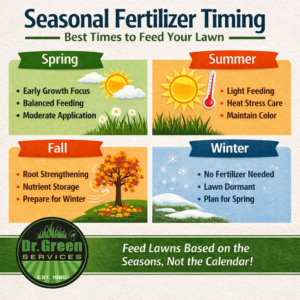
Grass uses nutrients differently as conditions change. For example, during active growth, roots absorb and store nutrients efficiently. During stress or dormancy, however, uptake slows dramatically.
As a result, fertilizer timing directly affects:
-
Root development
-
Density and color
-
Stress tolerance
-
Long-term lawn health
When fertilizer is applied at the wrong time, it can force top growth, weaken roots, or increase disease risk. In contrast, properly timed applications strengthen the lawn from the ground up. In fact, university research on how lawns respond to seasonal changes shows that nutrient uptake closely follows growth cycles rather than calendar dates.
Spring Fertilizer Timing and Early Growth
In spring, grass focuses on recovering from winter and rebuilding leaf tissue. As soil temperatures rise, roots become active, and nutrient demand increases. During this period, grass responds quickly to available nutrients, especially nitrogen, which plays a key role in leaf development and early growth, a process explained in nitrogen fertilizer science.
However, timing still matters. When fertilizer is applied too early, it often leads to excessive blade growth before roots fully recover. Because of that imbalance, turf may weaken heading into summer.
Well-timed spring fertilizer, therefore, supports:
-
Steady green-up
-
Balanced shoot and root growth
-
Improved nutrient efficiency
Rather than pushing fast growth, spring timing should prepare the lawn for the stress ahead.
Summer Fertilizer Timing and Stress Management
During summer, lawns face heat, drought pressure, and heavy traffic. As a result, grass shifts energy away from growth and toward survival. Because nutrient uptake slows during heat stress, fertilizer performance depends heavily on how quickly nutrients are released, a difference explained in slow-release vs quick-release fertilizer.
Because nutrient uptake slows in high heat, fertilizer timing must adjust accordingly. Heavy applications during peak summer can overload grass, which increases burn risk and disease pressure.
Instead, proper summer timing focuses on:
-
Maintaining color without forcing growth
-
Supporting root function
-
Improving stress tolerance
This controlled approach helps lawns stay resilient during harsh conditions rather than breaking down under stress.
Fall Fertilizer Timing and Root Strength
Fall is the most important season for fertilizer timing. Because temperatures cool and moisture levels stabilize, conditions become ideal for nutrient absorption. During fall, nutrient focus shifts below ground, where phosphorus supports root development and potassium improves stress tolerance and winter survival, differences explained in phosphorus vs potassium fertilizer.
During this period, grass prioritizes root growth and energy storage rather than blade production. As a result, fertilizer applied in fall fuels deeper roots and prepares turf for winter dormancy.
Fall fertilizer timing supports:
-
Stronger root systems
-
Improved winter survival
-
Faster spring recovery
For this reason, fall applications often deliver the greatest long-term results.
How Grass Type Affects Seasonal Fertilizer Timing
Not all lawns follow the same schedule. Because cool-season and warm-season grasses grow at different times, fertilizer timing must adjust.
Cool-season grasses:
-
Grow most actively in spring and fall
-
Therefore require reduced summer feeding
Warm-season grasses:
-
Peak in late spring and summer
-
As a result, require little to no fall feeding
Understanding grass type ensures fertilizer aligns with actual growth rather than assumptions.
Why Calendar-Based Fertilizing Fails
Many homeowners fertilize by date instead of conditions. Unfortunately, weather patterns change every year, and fixed schedules often fail to account for how turf actually responds to environmental stress.
For example, rainfall, temperature swings, and soil conditions all influence nutrient uptake. When fertilization does not align with these variables, turf growth slows and stress increases — conditions commonly associated with diseases such as brown patch fungus and dollar spot fungus.
Seasonal fertilizer timing works because it adapts. Instead of relying on dates, it responds to how the lawn behaves, helping maintain steady growth and reduce disease pressure over time.
How Professional Lawn Care Uses Seasonal Fertilizer Timing
Professional lawn care providers monitor soil temperature, growth response, and weather trends before applying fertilizer. Because of this, nutrients work efficiently rather than being lost to runoff or stress.
At Dr. Green Services, fertilizer timing is adjusted throughout the season to match real lawn conditions. As a result, lawns develop stronger roots, improved density, and better resilience over time.
Ultimately, this science-based approach explains why professional programs deliver more consistent and lasting results. For homeowners who want to better understand the science behind these decisions, our lawn care resources provide in-depth guidance on how timing, nutrients, and seasonal conditions work together to support healthy lawns.
Hear What Our Happy Customers Have to Say!
For a Limited Time
Get Started Today and Enjoy Our Special Offer: Free Grub Control, Free Aeration, Free Fungicide, and Free Turf-Damaging Insect Control! Plus, Save 10% When You Prepay!
Your Local Lawn Care Experts
Dallas-Fort Worth
Address
3333 Earhart Dr., Suite 200
Carrollton, TX 75006
Phone Number
1-800-465-2934
Ready to elevate your lawn care game?
Get a free quote today.