
Grass Seed Germination
Grass seed germination is the biological process that allows new grass plants to emerge, develop roots, and establish long-term turf density. For bluegrass lawns, this process follows a slower and more precise timeline than many other grass types—a principle rooted in foundational lawn care science.
Understanding how bluegrass seeds sprout and establish helps explain why timing, soil conditions, moisture, and surface contact determine success. Instead of relying on shortcuts, science-based lawn care focuses on supporting early growth from the soil up, which is central to lawn seeding science and long-term turf establishment.
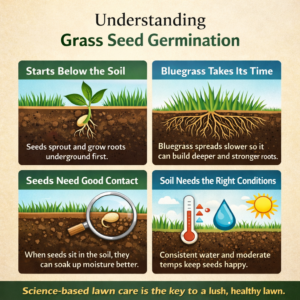
Grass Seed Germination Begins Below the Surface
This process begins when a seed absorbs moisture and activates internal growth mechanisms. Early development occurs below the soil surface and is not immediately visible.
In bluegrass, moisture triggers enzymes that convert stored energy into new tissue. As a result, the plant produces its first root before any blade appears above ground—a process supported by university research on selecting grass seed suited for long-term lawn success.
If soil dries too quickly or remains compacted, early development slows or stops entirely.
Why Grass Seed Germination Takes Longer in Bluegrass
Establishment speed varies by grass species. Kentucky bluegrass naturally develops more slowly than ryegrass or fescue because it prioritizes underground growth.
This extended timeline allows bluegrass to form stronger root systems that support spreading and long-term density. However, it also means young seedlings remain vulnerable to stress for a longer period.
Because of this, success depends on stable conditions rather than rapid surface growth.
Grass Seed Germination Depends on Soil Contact
One of the most overlooked factors in successful establishment is direct contact with soil. Seeds resting on thatch, dry surfaces, or loose debris struggle to absorb water evenly.
Proper contact allows moisture to surround the seed while still providing oxygen. This balance supports steady root emergence and reduces the risk of drying out.
Improving soil structure without disturbing seed placement creates a more favorable environment for early growth.
Moisture Timing and Grass Seed Germination
Consistent moisture is essential during early establishment, but excess water can be just as damaging as drought. Seeds must remain hydrated without becoming saturated.
When soil stays overly wet, oxygen levels decline and seeds may decay before sprouting. Conversely, even brief dry periods during early growth can interrupt development.
For bluegrass lawns, steady moisture over time supports uniform emergence and stronger establishment.
Temperature’s Role in Grass Seed Germination
Soil temperature plays a critical role during early development. Bluegrass establishes best when soil temperatures remain moderate and stable.
Extreme heat slows internal activity within the seed, while cooler soil delays metabolic processes. This explains why bluegrass seeding aligns with seasonal transitions rather than fixed calendar dates.
Monitoring soil conditions helps explain why identical seeding efforts can produce different results each year.
Root Development During Grass Seed Germination
Early root growth occurs before visible leaf growth. These roots anchor the plant, absorb water, and store energy.
If roots fail to establish properly, seedlings may emerge briefly and then collapse under stress. Strong early root development increases drought tolerance and improves long-term turf resilience.
Healthy establishment produces plants that recover more effectively from mowing, traffic, and environmental pressure.
How Grass Seed Germination Affects Lawn Density
Successful establishment directly influences how well a lawn fills in over time. Each healthy seed contributes to thicker turf that resists weeds, disease, and insect pressure.
In bluegrass lawns, strong early development also supports lateral spreading through rhizomes. This growth habit allows turf to repair thin areas well beyond the initial seeding window.
When establishment is uneven, lawns remain patchy and vulnerable even after seed is applied.
Grass Seed Germination Is a Process, Not a Product
This process cannot be forced through quick fixes or products alone. Biology sets the rules.
Results depend on creating conditions that allow the seed to complete its natural growth cycle. Soil structure, moisture balance, temperature, and surface contact all work together.
When these factors align, bluegrass lawns establish deeper roots, stronger density, and improved long-term performance.
Science-Based Lawn Care Supports Grass Seed Germination
At Dr. Green Services, lawn care decisions are guided by turf biology rather than guesswork. This process is treated as a system that depends on timing, soil health, and reduced stress—principles that guide our lawn seeding service.
By supporting root development and minimizing environmental barriers, lawns establish more reliably and recover more efficiently. This science-driven approach reflects the same standards found throughout our lawn care resources, where education and long-term results go hand in hand.
Hear What Our Happy Customers Have to Say!
For a Limited Time
Get Started Today and Enjoy Our Special Offer: Free Grub Control, Free Aeration, Free Fungicide, and Free Turf-Damaging Insect Control! Plus, Save 10% When You Prepay!
Your Local Lawn Care Experts
Dallas-Fort Worth
Address
3333 Earhart Dr., Suite 200
Carrollton, TX 75006
Phone Number
1-800-465-2934
Ready to elevate your lawn care game?
Get a free quote today.