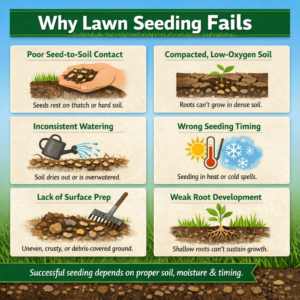
Why Lawn Seeding Fails When Seed-to-Soil Contact Is Poor
One of the most common reasons why lawn seeding fails is inadequate seed-to-soil contact. Grass seed must remain in direct contact with soil to absorb moisture and activate germination. However, when seed rests on top of thatch, compacted ground, or debris, moisture evaporates before the process can begin.
As a result, seed dries out between watering cycles and fails to establish. To improve success, light raking after seeding helps settle seed into the soil surface. In addition, adding a thin layer of soil in bare areas protects seed and improves moisture retention.
Seeding Fails in Compacted, Low-Oxygen Soil
Another key reason why lawn seeding fails involves soil compaction. Compacted soil restricts oxygen movement, which is critical for early root development. Without adequate oxygen, newly germinated roots cannot expand or absorb nutrients efficiently.
Because bluegrass seedlings rely on fine root systems, restricted airflow quickly weakens young plants. Consequently, seedlings decline once watering is reduced. Improving soil structure and oxygen flow creates a healthier environment for roots to establish and persist.
Moisture Errors That Explain Why Lawn Seeding Fails
Watering practices strongly influence seeding outcomes. In fact, inconsistent moisture is one of the clearest explanations for why lawn seeding fails. During germination, grass seed requires steady moisture to survive and complete early growth stages, a point consistently supported by university extension guidance on seeding and sodding home lawns.
If the soil dries out, even briefly, developing seedlings can die. On the other hand, excessive watering limits oxygen and slows root development. Therefore, short and frequent watering cycles are most effective early on. Over time, watering should gradually shift to deeper applications to support stronger roots.
When Bluegrass Is Seeded at the Wrong Time
Timing plays a critical role in bluegrass establishment. Many failures occur because seed is applied during periods of environmental stress. As a result, why lawn seeding fails is often tied directly to poor timing.
When soil temperatures are too high or too low, germination slows or stops altogether. Additionally, seedlings seeded outside optimal growth windows face stress before roots can establish. Even with proper watering and soil preparation, incorrect timing often leads to disappointing results.
Surface Preparation Issues That Show Why Lawn Seeding Fails
Surface conditions also influence seeding success. Uneven soil, crusted surfaces, or leftover debris block seed contact and limit moisture retention. Consequently, these issues frequently explain why seeding fails despite good intentions.
Light raking helps loosen the surface layer and removes barriers that interfere with germination. Furthermore, adding soil to thin or bare areas creates a smoother surface and improves moisture stability. These simple steps significantly increase germination potential.
Why Seeding Fails After Germination Begins
In some cases, seed germinates but fails shortly afterward. At this stage, weak root development is usually the cause. Understanding why lawn seeding fails includes recognizing that visible growth does not guarantee long-term success.
If soil remains compacted or watering changes too quickly, roots cannot support the plant. Consequently, seedlings thin out or disappear entirely. Supporting root expansion through improved soil conditions and gradual watering adjustments helps prevent this type of failure.
How Understanding Why Lawn Seeding Fails Improves Long-Term Lawn Health
Ultimately, seeding success depends on aligning lawn practices with turf biology. When homeowners understand why lawn seeding fails, they can make informed decisions that support long-term turf density rather than short-term appearance. For those looking to apply this science in real-world conditions, a professional seeding service can help ensure timing, preparation, and follow-up practices are handled correctly.
Seed-to-soil contact, oxygen availability, moisture consistency, proper timing, and surface preparation all work together. When these elements are addressed, bluegrass lawns establish more evenly and maintain healthier growth over time. Additional guidance on supporting these processes can be found throughout comprehensive lawn care resources. By treating seeding as a biological system instead of a one-time task, lawns recover more reliably and perform better season after season.