
Why Seed to Soil Contact Matters in Lawn Seeding
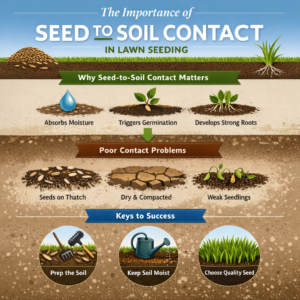
Successful lawn seeding depends on more than spreading seed evenly across the lawn and is best understood within the broader principles of lawn care science. Seed to soil contact determines whether grass seed can absorb moisture, begin germination, and develop roots. Without direct contact with the soil surface, even high-quality bluegrass seed may struggle to establish.
In many cases, seed rests on thatch, loose debris, or compacted surfaces. As a result, moisture evaporates quickly and germination becomes inconsistent. Over time, seedlings weaken or fail entirely. Because of this, understanding how proper contact works is a core principle of lawn seeding science.
Seed to Soil Contact and Bluegrass Germination
Bluegrass seed begins germination only when moisture remains consistently available at the seed surface. Therefore, physical contact between seed and soil particles is essential, as explained by the University of Illinois Extension. When this contact is present, soil holds moisture near the seed coat and supports early biological activity.
However, bluegrass establishes more slowly than many other grass types. Because of this slower pace, even short dry periods can interrupt germination. When contact is inconsistent, seeds may dry out between waterings or shift position before roots can anchor into the soil.
How Poor Seed Placement Leads to Thin Lawns
Many seeding failures occur even when timing and seed quality are correct. In most situations, the underlying issue is poor placement rather than poor materials. Compacted soil, excess thatch, and uneven surfaces all prevent seed from settling into stable positions.
As a result, germination becomes uneven across the lawn. Some areas establish while others remain thin. Over time, these gaps reduce density and leave the lawn more vulnerable to weeds and environmental stress.
Seed to Soil Contact Without Mechanical Aeration
Achieving reliable seed to soil contact does not require aggressive soil disruption. In fact, maintaining a stable surface often improves consistency during germination. Liquid aeration improves soil conditions below the surface while preserving surface structure above it.
As soil porosity improves, seed can settle naturally into the upper soil layer. Consequently, moisture movement becomes more consistent and early root development improves without creating surface instability.
Surface Preparation and Seed to Soil Contact
Soil surface preparation plays a significant role in achieving effective soil contact. Light raking helps expose soil between existing grass blades. At the same time, adding small amounts of soil to low or bare areas helps level the surface.
Together, these steps allow seed to rest directly against moist soil. As a result, seed is less likely to dry out, wash away, or remain suspended above the soil line.
Watering and Maintaining Proper Contact
Even when placement is correct, watering practices determine whether contact is maintained during early germination. For this reason, light and frequent watering is essential. This approach keeps the soil surface moist without disturbing seed placement.
On the other hand, heavy watering can dislodge seed and reduce contact, especially on uneven lawns. When moisture remains consistent—particularly during the best time to seed—roots develop more quickly and seedlings become securely anchored.
Why Proper Contact Supports Long-Term Lawn Health
Strong contact between seed and soil supports uniform establishment. As a result, lawns develop more even density and stronger root systems. Over time, this improves resistance to weeds, stress, and seasonal pressure.
Because establishment is more uniform, lawns recover more reliably and maintain better long-term performance.
Seed to Soil Contact as a Foundation of Lawn Seeding Science
Seed to soil contact remains one of the most important factors in bluegrass seeding success and directly influences the results of professional seeding services. When soil conditions, surface preparation, and watering work together, germination becomes far more predictable.
For this reason, the concept serves as a foundational principle of lawn seeding science and plays a critical role in long-term turf stability within trusted lawn care resources.
Hear What Our Happy Customers Have to Say!
For a Limited Time
Get Started Today and Enjoy Our Special Offer: Free Grub Control, Free Aeration, Free Fungicide, and Free Turf-Damaging Insect Control! Plus, Save 10% When You Prepay!
Your Local Lawn Care Experts
Dallas-Fort Worth
Address
3333 Earhart Dr., Suite 200
Carrollton, TX 75006
Phone Number
1-800-465-2934
Ready to elevate your lawn care game?
Get a free quote today.