
Causes of Soil Compaction in Lawns
Causes of soil compaction explain why lawn soil becomes dense, firm, and difficult for grass to grow in over time. Although compacted soil often develops slowly, it rarely forms without a reason. Instead, repeated pressure, environmental conditions, and soil structure steadily push soil particles closer together—a process closely connected to the principles explained in lawn aeration science.
Because this process happens below the surface, many homeowners do not notice the problem right away. However, once soil compaction sets in, lawns struggle to respond to normal watering and fertilization. That is why understanding what causes soil compaction matters so much within the broader context of lawn care science, where soil conditions, timing, and treatment strategy all work together.
At Dr. Green Services, lawn care decisions start with identifying the causes of soil compaction first. By addressing the source of the problem, treatments focus on lasting improvement rather than temporary surface results.
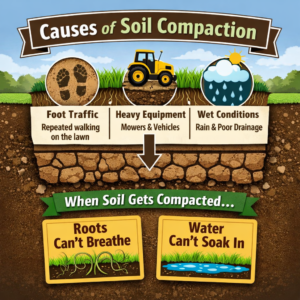
Causes of Soil Compaction from Foot Traffic
Foot traffic remains one of the most common causes of soil compaction in residential lawns. Every step places downward pressure on the soil. Over time, that pressure reduces the natural spacing between soil particles.
In addition, foot traffic often concentrates in the same areas. For example, children and pets usually play in familiar spots. Likewise, homeowners tend to walk the same paths across the lawn each day. As a result, those areas compact faster than the rest of the yard.
Eventually, repeated pressure turns flexible soil into a dense layer beneath the grass. When this happens, turf begins to thin even though the surface may still look intact. Over time, repeated pressure forces soil particles closer together, which reduces flexibility in the soil structure, as explained in USDA research on the biology of soil compaction.
Causes of Soil Compaction from Heavy Lawn Equipment
Heavy lawn equipment also plays a major role in the causes of soil compaction. Lawn mowers, service vehicles, and construction equipment apply far more weight than foot traffic alone.
Moreover, compaction develops faster when equipment follows the same route repeatedly. This situation often occurs during routine mowing or lawn treatments. In addition, equipment use causes more damage when soil is already moist.
Even a single season of repeated equipment use can compress soil layers below the surface. Once those layers form, normal lawn maintenance cannot reverse the damage without professional lawn care service.
Clay-Heavy Soil and Compaction Risk
Soil type strongly influences how easily compaction occurs. In particular, lawns with clay-heavy soil face a much higher risk.
Clay particles are extremely small and naturally sit close together. Because of this structure, pressure pushes clay particles even tighter. As a result, clay soil becomes dense faster than sandy or loamy soil.
Furthermore, clay-heavy soil holds moisture longer. That moisture makes the soil more vulnerable to pressure from traffic and equipment. Therefore, lawns in clay-rich regions often develop compaction even with moderate use. Because clay-heavy soil compacts so easily, choosing the right aeration approach becomes critical, which is why understanding liquid aeration vs core aeration helps determine which method actually corrects dense soil structure.
How Wet Conditions Increase the Causes of Soil Compaction
Wet soil dramatically increases the causes of soil compaction. When soil becomes saturated, water fills the spaces between soil particles. Consequently, those particles shift and compress more easily under pressure.
For this reason, walking or mowing on wet lawns causes far more damage than doing so on dry soil. Likewise, using equipment on soggy ground quickly compresses the soil structure.
Afterward, soil often dries in its compacted state. Over time, repeated exposure to wet conditions creates deeper and more persistent compaction layers that are harder to correct and severely restrict oxygen flow to roots, which directly affects long-term turf health.
Poor Drainage and Repeated Compaction
Poor drainage closely connects to soil compaction. When water drains slowly or pools on the lawn surface, soil remains soft and vulnerable to pressure.
In many cases, compaction and drainage problems reinforce each other. Poor drainage keeps soil wet. Wet soil compacts more easily. Compacted soil then slows drainage even further. As this cycle continues, soil conditions steadily decline.
Eventually, lawns affected by poor drainage and compaction struggle to recover without targeted lawn care solutions.
Natural Settling as a Cause of Soil Compaction
Not all causes of soil compaction involve traffic or equipment. In some cases, soil compacts naturally as it settles over time, which directly limits root growth and overall turf performance.
This issue commonly appears in newly established lawns, backfilled areas, or places disturbed by construction. As soil settles, air pockets collapse. Consequently, soil density increases even without visible surface damage, making it harder for roots to expand and function properly.
Without corrective lawn care, naturally compacted soil continues to harden. Over time, these areas often become weak points in the lawn, which explains how aeration improves roots by restoring space, airflow, and healthier root development.
Why Understanding the Causes of Soil Compaction Matters
Understanding the causes of soil compaction helps prevent recurring lawn problems. If the source of compaction remains unaddressed, grass continues to struggle regardless of watering or fertilization. This is why learning the science behind healthy turf through lawn care resources plays such an important role in long-term lawn success.
At Dr. Green Services, lawn care strategies focus on identifying why compaction formed in the first place. From there, professional aeration services are selected to match soil conditions, lawn use, and regional factors. Because this approach follows lawn care science, it supports healthier turf and stronger long-term results.
Hear What Our Happy Customers Have to Say!
For a Limited Time
Get Started Today and Enjoy Our Special Offer: Free Grub Control, Free Aeration, Free Fungicide, and Free Turf-Damaging Insect Control! Plus, Save 10% When You Prepay!
Your Local Lawn Care Experts
Dallas-Fort Worth
Address
3333 Earhart Dr., Suite 200
Carrollton, TX 75006
Phone Number
1-800-465-2934
Ready to elevate your lawn care game?
Get a free quote today.