
Preventative Grub Control vs Curative Treatments
Preventative grub control focuses on stopping lawn damage before it starts. Instead of reacting to visible problems, this approach interrupts grub development early, protecting grass roots long before turf shows stress. This approach aligns closely with grub control science, which centers on biological timing rather than surface symptoms. In contrast, curative treatments respond after damage appears, often when root systems are already compromised.
Understanding the difference between these strategies helps explain why timing matters so much in effective grub control and how broader lawn care science supports proactive, prevention-based management.
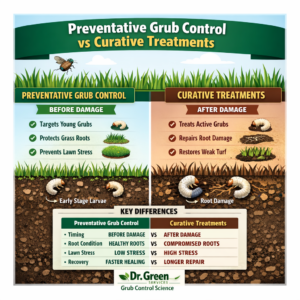
What Preventative Grub Control Means
Grub control targets grubs before they begin feeding heavily on grass roots. Treatments are applied during specific biological windows, when beetle eggs hatch and larvae are small.
At this stage, grubs are:
-
Located near the soil surface
-
Actively developing
-
More vulnerable to control products
Because grass roots have not yet suffered feeding pressure, lawns maintain stability, nutrient uptake, and water absorption. University research on controlling grubs in lawns and turfgrass consistently shows that early-stage larvae are far more vulnerable to treatment than mature grubs, which is why timing plays such a critical role in success.
This science-based timing makes preventative grub control the most effective long-term strategy.
How Curative Grub Control Works
Curative treatments are applied after grub damage becomes visible. At this point, lawns often show:
-
Thinning or yellowing grass
-
Wilting despite proper watering
-
Turf that pulls up easily due to root loss
Although curative control can reduce active grub populations, it cannot reverse existing root damage. As a result, lawns require additional recovery time even after treatment.
Curative grub control plays an important role, but it functions as a damage response, not a prevention strategy.
Preventative Grub Control Protects Grass Roots Early
Grass roots anchor turf and supply water and nutrients. When grubs feed on these roots, lawns lose their ability to support healthy growth.
Grub control protects roots by:
-
Interrupting feeding before it begins
-
Preserving root density and depth
-
Maintaining soil-to-root contact
Because roots remain intact, lawns recover faster from heat, drought, and traffic stress.
This direct connection between grub timing and root protection explains why early intervention delivers better results.
Why Timing Matters in Grub Control Science
Grubs follow a predictable development cycle. Feeding intensity increases as larvae mature. Therefore, the earlier control occurs, the less damage they can cause.
Grub control aligns treatments with:
-
Egg hatch periods
-
Early larval development
-
Peak vulnerability stages
In contrast, curative treatments often occur during later stages, when feeding pressure is already high.
For this reason, professional lawn care focuses on biological timing, not visible symptoms alone.
Preventative vs Curative Grub Control: Key Differences
| Factor | Preventative Grub Control | Curative Grub Control |
|---|---|---|
| Timing | Before feeding damage | After damage appears |
| Root protection | Preserves roots | Roots already compromised |
| Lawn stress | Minimal | Often severe |
| Recovery time | Faster | Longer |
| Long-term results | Stronger turf | Damage control |
This comparison highlights why preventative grub control supports healthier lawns season after season.
When Curative Grub Control Is Still Necessary
Despite best efforts, curative grub control is sometimes required. This often happens when:
-
Preventative treatments were missed
-
Beetle pressure was unusually high
-
Previous root damage weakened turf
In these cases, curative control helps stop further feeding and prevents total turf loss. However, follow-up care is usually needed to restore root strength and lawn density.
Why Professional Grub Control Improves Outcomes
Preventative grub control depends on precision. Timing must match grub development, soil conditions, and regional climate patterns.
Professional lawn care improves results by:
-
Monitoring beetle activity
-
Applying treatments during optimal windows
-
Adjusting strategies based on lawn conditions
This proactive approach prevents damage rather than reacting to it.
Long-Term Lawn Health Starts With Prevention
Preventative grub control focuses on stopping lawn damage before it starts. Instead of reacting to visible problems, this approach interrupts grub development early, protecting grass roots long before turf shows stress. This approach aligns closely with grub control science, which centers on biological timing rather than surface symptoms. In contrast, curative treatments respond after damage appears, often when root systems are already compromised.
Understanding the difference between these strategies helps explain why timing matters so much in effective grub control. For homeowners looking to apply this science in real-world conditions, professional grub control services and ongoing lawn care resources help ensure prevention happens before damage becomes visible.
Hear What Our Happy Customers Have to Say!
For a Limited Time
Get Started Today and Enjoy Our Special Offer: Free Grub Control, Free Aeration, Free Fungicide, and Free Turf-Damaging Insect Control! Plus, Save 10% When You Prepay!
Your Local Lawn Care Experts
Dallas-Fort Worth
Address
3333 Earhart Dr., Suite 200
Carrollton, TX 75006
Phone Number
1-800-465-2934
Ready to elevate your lawn care game?
Get a free quote today.