
Crabgrass Growth Cycle: How Soil Temperature Drives Seasonal Emergence
Crabgrass is a warm-season annual grass that follows a predictable biological pattern each year. Rather than behaving like a traditional invasive weed, crabgrass responds directly to soil temperature, sunlight, and turf conditions, all of which are core principles in lawn care science. Understanding the crabgrass growth cycle explains why timing plays a far greater role than surface treatments alone.
This page explains how crabgrass develops from dormant seed to seasonal completion and why weed control science focuses on early biological triggers instead of reacting to visible summer growth.
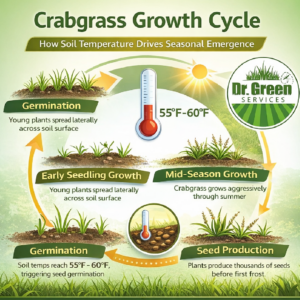
Crabgrass Growth Cycle and Annual Plant Biology
The crabgrass growth cycle follows the behavior of an annual grassy plant. Unlike perennial turfgrass, crabgrass completes its entire life cycle in a single growing season. Each year begins with seeds that survived winter dormancy in the soil, a process well documented in university turfgrass research on crabgrass biology and germination.
Crabgrass does not spread through underground roots or rhizomes. Its persistence depends entirely on seed production and environmental timing. When conditions repeat, the growth cycle repeats. This explains why crabgrass often reappears in the same lawn areas year after year when turf conditions remain unchanged.
Crabgrass Growth Cycle and Soil Temperature Triggers
The most critical stage of the crabgrass growth cycle begins below the surface. Germination starts when soil temperatures consistently reach approximately 55°F to 60°F near the upper soil layer. Once this threshold is met, dormant seeds activate and begin growth.
Soil temperature is more reliable than air temperature. Brief warm spells followed by cool nights can delay germination even when lawns appear green. Because of this, calendar-based assumptions often fail to match real biological activity.
Soil Moisture and Light Exposure Influence Germination
While temperature initiates germination, soil moisture and light exposure strongly influence success. Crabgrass seeds germinate more readily in areas where moisture is available near the surface and sunlight reaches the soil.
Thin turf, bare patches, and compacted areas allow greater light penetration. These conditions increase germination success and early establishment. Dense turf limits light at the soil surface, reducing the likelihood that seedlings survive after emergence.
Early Crabgrass Growth Cycle and Seedling Development
After germination, the crabgrass growth cycle moves quickly into seedling development. Young plants prioritize lateral growth across the soil surface instead of deep root formation. This allows rapid spread across open turf areas.
At this stage, crabgrass competes aggressively for sunlight and space. Lawns with poor density or uneven growth provide ideal conditions for expansion. Thick, actively growing turf naturally suppresses seedling success by limiting available space and light.
Crabgrass Growth Cycle During Mid-Season Heat
As temperatures rise, the crabgrass growth cycle enters its most aggressive phase. Crabgrass thrives in hot conditions that often stress cool-season turfgrass. During mid to late summer, plants become wider, tougher, and more drought tolerant.
This timing explains why crabgrass appears most visible later in the season. However, the biological process began weeks earlier. Summer dominance reflects successful early establishment rather than sudden infestation, a pattern that closely mirrors broader seasonal lawn growth cycles affecting turf response throughout the year.
Root Structure and Stress Adaptation
Crabgrass roots remain relatively shallow compared to perennial turfgrass. However, the plant compensates by spreading horizontally and conserving moisture efficiently. This adaptation allows crabgrass to survive heat and drought when surrounding turf weakens.
Because of this growth habit, stressed lawns often show increased crabgrass pressure during prolonged heat. Healthy root systems in turfgrass help reduce this competitive advantage.
Crabgrass Growth Cycle and Seed Production
In the final stage of the crabgrass growth cycle, plants shift energy from growth to reproduction. By late summer into early fall, each plant can produce thousands of seeds.
These seeds drop into the soil and enter dormancy before winter. Once freezing temperatures arrive, mature plants die. However, the seed bank remains intact, allowing the growth cycle to restart when soil temperatures rise the following year.
Why the Crabgrass Growth Cycle Matters for Lawn Care
Understanding the crabgrass growth cycle explains why surface-level reactions often produce inconsistent results. By the time crabgrass becomes visible, much of its biological development has already occurred.
Science-driven lawn care focuses on disrupting the cycle before germination begins. Addressing soil conditions, turf density, and early-season triggers reduces seedling success and limits long-term pressure, which is the foundation of effective preventative lawn care.
Using Growth Cycle Science to Support Healthier Lawns
Effective lawn care aligns treatments with biological timing, soil conditions, and turf strength. Preventing crabgrass establishment begins long before plants appear above the surface, just as long-term success with dandelion weed control depends on understanding plant biology rather than reacting to surface growth.
When growth cycle science is combined with consistent lawn care service and supported by reliable lawn care resources, turf remains denser, more resilient, and better equipped to resist seasonal grassy plant pressure year after year.
Hear What Our Happy Customers Have to Say!
For a Limited Time
Get Started Today and Enjoy Our Special Offer: Free Grub Control, Free Aeration, Free Fungicide, and Free Turf-Damaging Insect Control! Plus, Save 10% When You Prepay!
Your Local Lawn Care Experts
Dallas-Fort Worth
Address
3333 Earhart Dr., Suite 200
Carrollton, TX 75006
Phone Number
1-800-465-2934
Ready to elevate your lawn care game?
Get a free quote today.