
Preventative Insect Control Science
Preventative insect control focuses on reducing turf-damaging insect pressure before visible lawn damage occurs. Rather than reacting to thinning grass or brown patches, this approach builds on principles established in lawn care science that address the biological and environmental conditions allowing insects to establish.
Many surface-feeding and stem-feeding insects injure lawns long before symptoms appear. By the time damage becomes visible, populations are often already active. Understanding this timeline is a core concept within turf-damaging insect science, which explains why early intervention produces more reliable results.
This science-based approach is especially important for insects such as chinch bugs, sod webworms, armyworms, billbugs, and cutworms, which can cause rapid damage under favorable conditions.
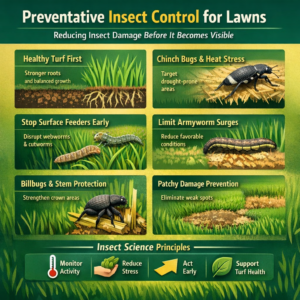
What Preventative Insect Control Means for Lawns
Preventative insect control does not rely on routine spraying or fixed schedules. Instead, it focuses on insect behavior, turf stress, and seasonal activity patterns, which are well documented in university turfgrass insect management research.
Most turf-damaging insects thrive when grass is weakened. Heat stress, drought stress, compaction, and shallow roots all reduce tolerance to feeding. Early management strategies aim to correct these conditions first.
When turf grows densely and maintains steady root development, insect feeding causes less injury and population growth slows naturally.
Preventative Insect Control vs Reactive Treatments
Reactive treatments respond after damage appears. Preventative control works earlier, when insect populations are smaller and turf is better able to recover.
Surface feeders such as sod webworms and cutworms often remain hidden during the day. As a result, injury may appear sudden even though insects have been present for weeks.
A prevention-focused approach limits outbreaks by reducing the conditions insects depend on rather than responding after visible decline.
Preventative Insect Control and Chinch Bug Activity
Chinch bugs are strongly associated with heat and drought stress. They thrive in dry, compacted soils where grass struggles to regulate moisture.
Preventative control targets these stress factors by promoting deeper roots, balanced moisture, and improved turf density. Healthier grass tolerates feeding more effectively and slows population expansion.
Because chinch bugs reproduce quickly during warm weather, early intervention plays a key role in limiting long-term damage.
Preventative Insect Control for Sod Webworms and Cutworms
Sod webworms and cutworms feed on grass blades and crowns, often leaving irregular brown patches. These insects prefer thin turf with exposed soil.
Preventative control emphasizes consistent growth and reduced open areas where larvae can establish. Dense turf disrupts feeding efficiency and interferes with egg-laying behavior.
As turf coverage improves, lawns become far less attractive to these surface-feeding insects during peak activity periods.
Armyworms and Early Insect Prevention
Armyworms can cause widespread damage in a short period of time, especially during warm, humid conditions. Their feeding often resembles drought or disease stress, which delays accurate identification.
Early insect prevention helps reduce outbreak potential by strengthening turf before conditions favor rapid feeding. Grass with steady growth and strong recovery capacity tolerates short-term pressure more effectively.
Reducing stress early limits how quickly populations can overwhelm turf.
Preventative Insect Control for Billbugs and Stem Feeders
Billbugs damage lawns by feeding inside stems and crowns. Because this injury occurs internally, symptoms often appear after significant damage has already occurred.
Preventative control addresses this vulnerability by supporting crown strength and steady growth. Lawns with healthier crowns are less likely to collapse when internal feeding begins.
This approach reduces reliance on reactionary treatments while improving long-term turf stability.
Why Preventative Control Reduces Patchy Damage
Many turf-damaging insects create patchy damage rather than uniform decline. This happens because insects concentrate feeding in stressed or weakened areas.
Preventative control works to reduce these weak zones by improving overall lawn uniformity. When turf health is consistent, insect pressure spreads less efficiently.
This is why prevention-based programs often limit secondary issues such as weeds and disease as well.
Timing and Turf-Damaging Insect Prevention
Insects follow predictable life cycles influenced by temperature, moisture, and turf condition. Preventative insect control aligns management decisions with these biological patterns rather than calendar dates.
Monitoring lawn stress and growth trends allows action before populations peak. Proper timing reduces the need for aggressive intervention later in the season.
Consistent prevention produces more reliable outcomes than sporadic responses.
Long-Term Benefits of Preventative Insect Control
Preventative control supports more than insect resistance. By prioritizing turf biology, it strengthens roots, improves recovery, and increases tolerance to environmental stress.
Over time, lawns managed proactively experience fewer severe outbreaks and recover faster when pressure occurs.
This integrated approach explains why prevention-driven programs deliver more stable results season after season.
Preventative Insect Control Within Turf-Damaging Insect Science
Preventative insect control serves as a foundation of turf-damaging insect science. Instead of treating insects as isolated problems, it addresses the shared conditions that allow multiple species to thrive—an approach reflected in professional turf-damaging insect control services designed around turf biology rather than reaction.
By combining biological understanding with proactive lawn care practices, this strategy reduces overall insect pressure while supporting healthier turf. Many of these principles are also reinforced through broader lawn care resources that focus on stress reduction, root health, and long-term turf stability.
Hear What Our Happy Customers Have to Say!
For a Limited Time
Get Started Today and Enjoy Our Special Offer: Free Grub Control, Free Aeration, Free Fungicide, and Free Turf-Damaging Insect Control! Plus, Save 10% When You Prepay!
Your Local Lawn Care Experts
Dallas-Fort Worth
Address
3333 Earhart Dr., Suite 200
Carrollton, TX 75006
Phone Number
1-800-465-2934
Ready to elevate your lawn care game?
Get a free quote today.