
Seasonal Pest Activity Explained
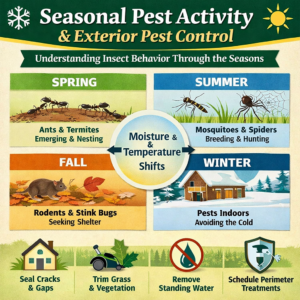
Seasonal pest activity refers to predictable changes in crawling insect behavior driven by temperature, moisture, and shelter availability. As explained throughout exterior pest control science, crawling insects respond rapidly to environmental shifts rather than remaining dormant for long periods. Unlike rodents or wildlife, their activity closely tracks changes in local conditions. As a result, pest pressure around homes rises and falls in consistent patterns throughout the year.
Understanding these biological patterns—similar to those explored in mosquito control science—helps explain why exterior pest activity often appears sudden, even when infestations have been developing quietly for weeks or months.
How Seasonal Pest Activity Is Driven by Temperature
Temperature plays the most important role in seasonal pest activity. Crawling insects are cold-blooded, meaning their metabolism, movement, and reproduction all depend on external heat. According to the U.S. Environmental Protection Agency’s Integrated Pest Management guidance, insect activity rises and falls in direct response to environmental conditions such as temperature and moisture.
As temperatures rise, insects become more active, feed more frequently, and reproduce faster. When temperatures drop, activity slows, but many species do not disappear. Instead, they seek protected areas near foundations, walls, and structural gaps where temperatures remain more stable.
This biological response explains why crawling pests often increase around homes during seasonal transitions rather than during extreme heat or cold.
Seasonal Pest Activity and Moisture Availability
Moisture strongly influences where crawling insects live and travel. Many common pests require damp environments to survive, reproduce, or forage effectively.
Rainfall, irrigation, humidity, and poor drainage can all increase seasonal pest activity by creating favorable conditions near foundations, mulch beds, and shaded areas. During dry periods, pests often move closer to structures in search of moisture, increasing contact with exterior surfaces.
As moisture patterns change with the seasons, pest pressure shifts accordingly.
Pest Activity Around Home Exteriors
Crawling insects commonly use foundation edges, siding transitions, expansion joints, and entry gaps as travel routes, including pathways that influence fleas and pets as they move between outdoor and indoor environments. As outdoor conditions fluctuate, these areas become staging zones rather than random invasion points.
This is why pest activity often appears localized and persistent along exterior boundaries rather than evenly spread across a property—and why these same structural pathways also contribute to ticks and disease near the home.
Common Crawling Insects Influenced by Seasonal Changes
Some pests surge during warmer months due to increased reproduction. Others become more noticeable during cooler periods as they seek shelter. These shifts are biological responses, not signs of new infestations appearing overnight.
Recognizing these patterns helps distinguish seasonal movement from structural problems.
Why Seasonal Pest Activity Supports Preventive Control
Because pest activity follows predictable biological cycles, prevention is more effective than reaction. Once crawling insects establish protected travel routes near structures, populations become harder to disrupt.
Exterior-focused strategies—such as perimeter pest control—work by intercepting pests where seasonal movement naturally occurs. By targeting surfaces and entry zones influenced by temperature and moisture changes, pest pressure can be reduced before insects move indoors.
This science-based approach aligns pest control with environmental behavior rather than relying on short-term responses.
Understanding Seasonal Pest Activity as a Biological Cycle
Seasonal pest activity is not random. It is the result of environmental signals interacting with insect biology over time. Temperature shifts, moisture changes, and shelter availability work together to influence where pests travel and how long they persist near structures—principles that guide effective exterior pest control strategies.
By understanding these biological cycles, homeowners can better anticipate pest pressure and recognize why exterior treatments focus on prevention instead of visible infestations. Many of these same environmental factors are also addressed through proper property management and lawn care resources, which help reduce conditions that attract crawling insects. When pest control follows biology instead of symptoms, results remain more consistent throughout the year.
Hear What Our Happy Customers Have to Say!
For a Limited Time
Get Started Today and Enjoy Our Special Offer: Free Grub Control, Free Aeration, Free Fungicide, and Free Turf-Damaging Insect Control! Plus, Save 10% When You Prepay!
Your Local Lawn Care Experts
Dallas-Fort Worth
Address
3333 Earhart Dr., Suite 200
Carrollton, TX 75006
Phone Number
1-800-465-2934
Ready to elevate your lawn care game?
Get a free quote today.