
Seasonal Lawn Growth Cycles: How Grass Grows Through the Year
Seasonal lawn growth cycles explain how grass grows, slows down, and recovers throughout the year. Although lawns may look similar from month to month, grass follows predictable biological patterns driven by temperature, daylight, and moisture. Because of this, lawn care success depends on working with these natural patterns instead of relying on fixed calendar dates.
At Dr. Green Services, lawn care decisions follow how grass grows during each season, not fixed calendar dates. Because this approach is rooted in lawn care science, treatments align with natural growth patterns instead of forcing results. As a result, lawns build stronger roots, recover faster from stress, and stay healthier over the long term.
What Seasonal Lawn Growth Cycles Mean for Lawn Health
Grass constantly adjusts how it uses energy throughout the year. During favorable conditions, it prioritizes blade growth and recovery. During stressful periods, it slows visible growth to protect roots and stored energy.
These seasonal changes explain why lawns respond differently to mowing, fertilization, aeration, and traffic at different times of year. Applying the same approach year-round often leads to weak roots, thinning turf, or slow recovery. Research from the University of Illinois Extension shows that grass growth and stress tolerance change throughout the year, which is why proper timing plays such a critical role in lawn care success.
In Illinois and Indiana, most lawns contain cool-season grasses. These grasses thrive in cooler temperatures and struggle during heat, which makes understanding seasonal growth behavior especially important for long-term lawn health.
Seasonal Lawn Growth Cycles in Spring: Recovery and Top Growth
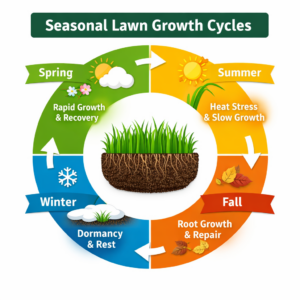
Spring marks the transition from dormancy to active growth. As soil temperatures rise, grass resumes photosynthesis and begins repairing winter damage. During this phase, most energy fuels new blade growth instead of deep root development.
Although lawns green up quickly, roots remain shallow early in the season. As a result, turf may look healthy while still being vulnerable to stress. Because compacted soil can limit oxygen and moisture movement, lawn aeration science shows that improving soil conditions during spring helps support early root function without overstimulating top growth. When mowing becomes too aggressive or treatments are applied at the wrong time, however, the lawn can weaken before summer heat arrives.
Because nutrient uptake increases during early growth, effective spring treatments follow the principles explained in lawn fertilizer science rather than relying on fixed schedules. In turn, spring lawn care works best when it supports steady growth while preparing turf for higher temperatures ahead.
Seasonal Lawn Growth Cycles in Summer: Stress Management and Survival
Summer introduces heat, drought pressure, and increased foot traffic. During this stage, cool-season grasses slow visible growth to conserve moisture and energy. At the same time, warm soil temperatures activate the crabgrass growth cycle, allowing annual grassy plants to expand while desirable turf struggles to keep pace.
Root growth often slows under prolonged heat stress. As a result, lawns recover more slowly from damage and may begin to thin. Because roots play a critical role in water and nutrient uptake, injury from below-ground pests becomes more severe during this time. Grub control science explains why root-feeding insects cause the greatest damage during summer, especially when turf is already stressed. Excessive fertilization or mowing during this period can further overwhelm grass and accelerate decline.
Effective summer lawn care focuses on protecting existing grass rather than forcing growth until conditions improve. In addition, lawn fungus science shows that heat and moisture stress can increase disease activity when turf lacks the strength to recover.
Seasonal Lawn Growth Cycles in Fall: Root Development and Energy Storage
Fall is the most important period for long-term turf health. Cooler air temperatures reduce stress, while soil remains warm enough to support strong root growth. During this time, grass shifts energy below the surface.
Roots grow deeper, thicken, and store nutrients needed for winter survival and spring green-up. Lawns also recover faster from thinning and damage during fall than at any other point in the year.
Because of this natural advantage, fall lawn care plays a major role in improving turf density and resilience, especially in Texas, where strong root reserves help lawns withstand winter freeze damage caused by sudden temperature swings.
Seasonal Lawn Growth Cycles During Winter Dormancy
Winter completes the annual growth pattern. As temperatures drop, grass enters dormancy and visible growth nearly stops. Although lawns appear inactive, crowns and roots remain alive beneath the soil.
Dormant grass conserves energy to survive freezing conditions. Damage that occurs during winter often becomes visible only after growth resumes in spring, which is why proper preparation before dormancy matters.
Lawns that enter winter healthy tend to green up faster and experience fewer problems the following season.
Why Seasonal Lawn Growth Cycles Matter for Lawn Care Timing
Understanding how grass grows throughout the year explains why timing matters more than effort. Because lawn care works best when treatments match what the plant is biologically prepared to do at each stage, a professional lawn care service can deliver better long-term results than treatments applied on a fixed schedule.
At Dr. Green Services, lawn care programs follow natural growth patterns to support root health, reduce stress, and improve recovery. As a result, this science-based approach produces more consistent results and stronger lawns over time.
Hear What Our Happy Customers Have to Say!
For a Limited Time
Get Started Today and Enjoy Our Special Offer: Free Grub Control, Free Aeration, Free Fungicide, and Free Turf-Damaging Insect Control! Plus, Save 10% When You Prepay!
Your Local Lawn Care Experts
Dallas-Fort Worth
Address
3333 Earhart Dr., Suite 200
Carrollton, TX 75006
Phone Number
1-800-465-2934
Ready to elevate your lawn care game?
Get a free quote today.