
Best Time to Seed Bluegrass Lawns
Understanding the best time to seed bluegrass lawns starts with turf biology, not tradition. Bluegrass establishes slowly, relies on consistent moisture, and requires favorable soil temperatures to develop strong roots—core principles covered in lawn care science. When seeding occurs at the wrong time, even high-quality seed struggles to survive.
This page explains when bluegrass seeding is most successful and why proper timing matters for long-term lawn density and durability, building on the foundational concepts of lawn seeding science.
Best Time to Seed Bluegrass Lawns
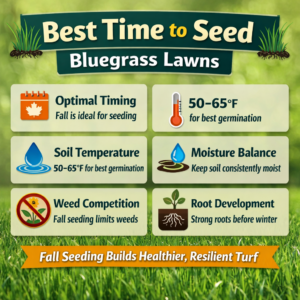
For cool-season turf like Kentucky bluegrass, the best time to seed occurs during fall. During this window, soil temperatures remain warm enough for germination while air temperatures begin to cool. This balance reduces stress on emerging seedlings and supports steady root growth, as supported by university turfgrass research on species selection and establishment.
Fall conditions also limit weed competition and disease pressure. As a result, bluegrass seedlings can focus energy on establishment rather than survival.
Why Fall Is the Best Time to Seed
Bluegrass seed germinates slowly compared to many grass types. Because of this, timing becomes critical. Fall provides longer periods of consistent soil moisture and reduced evaporation. These conditions allow seeds to remain hydrated throughout the germination process.
In addition, fall seeding aligns with the natural growth cycle of cool-season grasses. Root development continues even as top growth slows, which creates a stronger foundation before winter dormancy.
Soil Temperature Matters More Than Calendar Dates
When discussing the best time to seed, calendar dates are less important than soil temperature. Bluegrass seed performs best when soil temperatures range between 50°F and 65°F. Below this range, germination slows. Above it, stress and moisture loss increase.
Fall naturally maintains this temperature range longer than spring. This extended window improves seed-to-soil contact and supports uniform emergence.
Why Spring Is Less Reliable for Bluegrass Seeding
Although spring seeding is possible, it is not ideal. Spring brings rapid weed growth, fluctuating temperatures, and increasing heat stress. These factors compete directly with young bluegrass seedlings.
Because bluegrass establishes slowly, spring-seeded lawns often struggle before roots fully develop. Without enough time to mature, seedlings face higher failure rates as summer approaches.
Moisture Consistency During the Best Time to Seed
No matter the season, consistent moisture determines whether seeding succeeds. During the best time to seed, rainfall patterns and cooler temperatures help maintain surface moisture without oversaturation.
Short dry periods can halt germination entirely. This is why proper watering schedules and soil preparation are essential parts of successful bluegrass seeding.
How Soil Preparation Supports the Best Time to Seed
Timing alone is not enough. Even during the best time to seed, poor soil contact limits results. Surface compaction, thatch, and uneven soil prevent roots from anchoring properly.
Liquid aeration improves soil structure without disturbing existing turf. When combined with homeowner raking and light soil topdressing, seed contact improves and moisture penetrates more evenly. This preparation supports deeper rooting and more uniform establishment.
Regional Considerations for Bluegrass Seeding
Bluegrass seeding is only recommended in regions where cool-season turf thrives. In warmer climates, soil temperatures remain too high for reliable establishment. As a result, bluegrass seeding is not performed in southern regions where conditions favor warm-season grasses.
Proper seeding recommendations must always match regional turf biology.
Best Time to Seed for Long-Term Lawn Health
Choosing the best time to seed is about more than short-term appearance. Correct timing reduces stress, improves root development, and increases overall turf resilience—outcomes that guide professional seeding service recommendations. When bluegrass establishes under ideal conditions, it requires fewer corrections later.
By aligning seeding with natural growth cycles and proper soil preparation, lawns develop thicker coverage and stronger seasonal performance, which is why ongoing education through lawn care resources remains essential.
Hear What Our Happy Customers Have to Say!
For a Limited Time
Get Started Today and Enjoy Our Special Offer: Free Grub Control, Free Aeration, Free Fungicide, and Free Turf-Damaging Insect Control! Plus, Save 10% When You Prepay!
Your Local Lawn Care Experts
Dallas-Fort Worth
Address
3333 Earhart Dr., Suite 200
Carrollton, TX 75006
Phone Number
1-800-465-2934
Ready to elevate your lawn care game?
Get a free quote today.